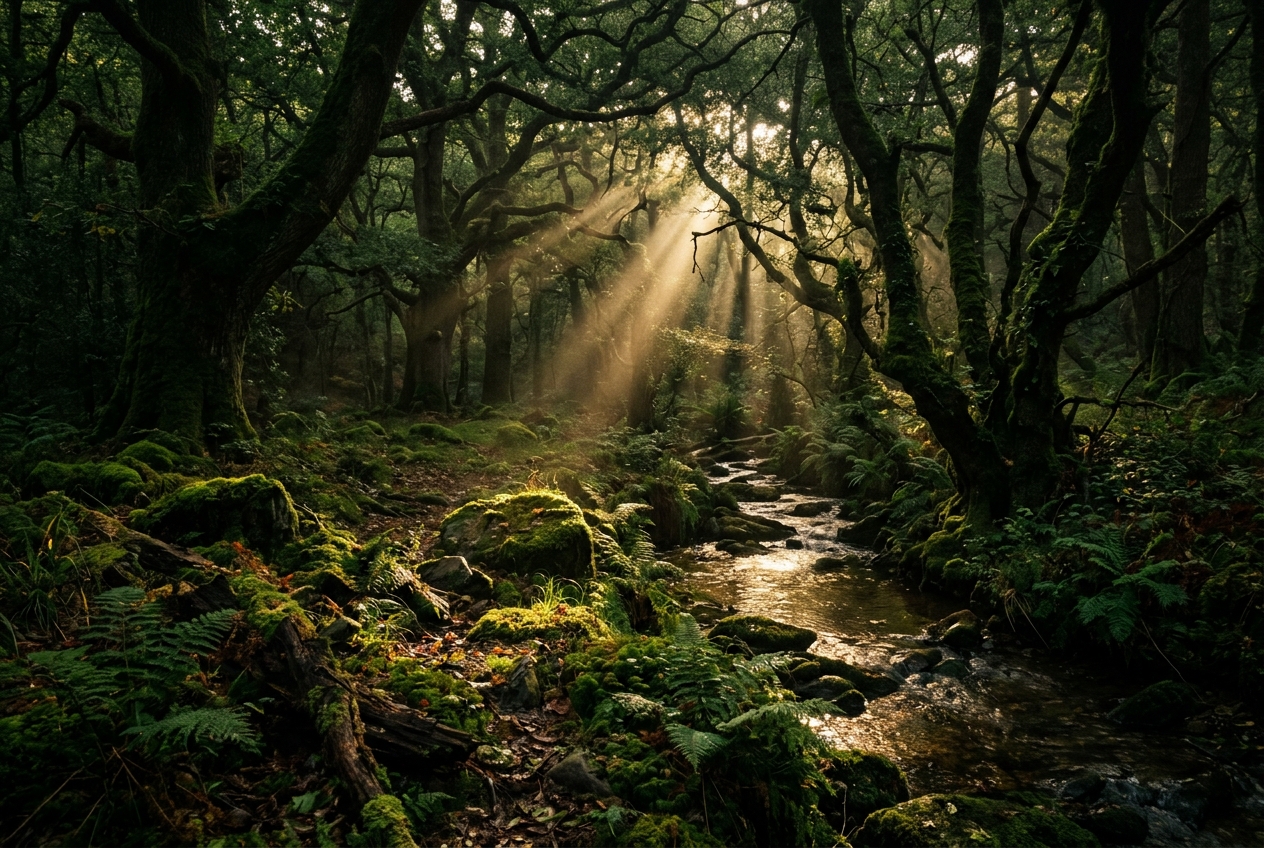
Why do we feel so much better after a walk in the woods, a swim in the sea or simply sitting beneath trees? For most of human history, nature was simply the backdrop to our lives, yet today millions of people actively seek out natural spaces as a remedy for stress, anxiety and exhaustion. This module explores how contact with nature supports subjective well-being: the constellation of life satisfaction, positive emotions and manageable negative feelings that characterises a flourishing life. Understanding this connection matters profoundly because urbanisation, digital saturation and inequality have created a world where many people experience nature scarcity, whilst research consistently shows that nature engagement predicts higher well-being across diverse cultures and economic contexts.
We will examine the biological and psychological mechanisms through which nature restores us, consider how societies are recognising this truth through policy and practice, and ask critical questions about access, equity and the limits of nature as a universal well-being solution. The evidence comes from neurobiological research, longitudinal studies and innovative public health programmes spanning Japan to New Zealand, Kenya to Iceland, revealing that our relationship with the natural world is not a luxury but a fundamental ingredient of human flourishing.
Defining Subjective Well-Being and Why Nature Matters
Subjective well-being encompasses three distinct dimensions: life satisfaction (our overall cognitive evaluation of how well life is going), the frequency and intensity of positive emotions (joy, contentment, interest, connection), and the experience of manageable rather than overwhelming negative emotions (sadness, worry, frustration). This understanding has become central to how governments and international organisations measure societal progress. The United Nations World Happiness Report, drawing on Gallup World Poll data, now treats subjective well-being as a primary indicator of national success alongside traditional economic metrics. New Zealand and Wales have embedded well-being into their budgeting and legislative frameworks, whilst the OECD has developed guidelines for measuring subjective well-being across member nations.
Nature engagement appears across all these frameworks as a consistent predictor of well-being. Research in countries from the Nordic welfare states to South Africa, from Australia to Ecuador, finds that people who spend time in natural environments report higher life satisfaction and more frequent positive emotions. What is particularly important is that this relationship holds across income levels, ages and cultural contexts, though the specific forms of nature engagement vary. This universality suggests something fundamental about human psychology and our evolutionary heritage. If we can understand how and why nature supports well-being, we can begin to design societies and policies that prioritise access to green and blue spaces as infrastructure for flourishing, not as optional amenities for the wealthy.
The Biophilia Hypothesis and Our Evolutionary Connection to Nature
E. O. Wilson's biophilia hypothesis proposes that humans possess an innate biological tendency to seek connection with nature and other living systems. This tendency, he argued, evolved because for the vast majority of human history, our ancestors survived by understanding natural systems intimately: tracking animals, identifying plants, reading weather patterns and seasons. Our brains and bodies became calibrated to natural environments. Even though only a few generations have lived in intensely urbanised, artificial settings, the deeper architecture of human psychology remains attuned to what we have lost.
The power of this hypothesis lies in explaining why nature contact feels so restorative rather than neutral. We are not simply choosing to relax in parks because parks are quieter; rather, something in our neurobiology recognises natural patterns, shapes and stimuli as fundamentally congruent with how our minds were shaped to function. This explains why artificial environments, however pleasant and well designed, often fail to produce the same well-being effects as genuine natural spaces. Cross-cultural research finds that this response is not culturally specific or learned. Children in Tokyo, Lagos, Lima and Copenhagen show similar attraction to natural elements long before cultural conditioning could fully operate. The biophilia hypothesis reminds us that our well-being is not purely psychological or social but is rooted in our embodied, evolutionary nature.
Restoration Through Attention and Stress Reduction
Rachel and Stephen Kaplan's attention restoration theory proposes that natural environments provide a particular kind of mental relief. Modern life demands focused, directed attention: concentrating on screens, tasks, conversations, decisions. This directed attention is cognitively taxing and depletes our mental resources over time, contributing to fatigue, irritability and difficulty concentrating. Natural environments, by contrast, are rich in what the Kaplans call soft fascination: elements that capture our attention gently and without effort. Birdsong, dappled light, moving water, plant forms and weather all draw our awareness without demanding the effortful concentration that exhausts us. In natural settings, the mind can wander, rest and restore its capacity for directed attention.
Roger Ulrich's stress reduction theory offers a complementary explanation grounded in our physiological responses. His research using controlled conditions (measuring heart rate, cortisol and brain activity) shows that even brief views of natural scenes activate the parasympathetic nervous system, the physiological state associated with relaxation and recovery. Blood pressure decreases, muscle tension releases and the body shifts from a state of alert vigilance to calm restoration. What is striking is the speed and robustness of this effect: measurable changes occur within minutes of nature exposure. These mechanisms are not unique to any single culture or climate. Whether the natural exposure is a Japanese garden, a South African savanna, a Nordic forest or an urban park in New Zealand, the fundamental neurobiological systems respond similarly, suggesting deep evolutionary roots.
Nature Connectedness and Global Practices
Beyond occasional visits to natural spaces, research now emphasises nature connectedness: a dispositional state of feeling emotionally and cognitively linked to the natural world. People with higher nature connectedness experience the well-being benefits of nature more deeply and consistently, partly because they actively seek nature contact and partly because they interpret their experiences within a framework of meaning and belonging. This is not mystical but measurable: individuals with stronger nature connectedness report higher life satisfaction, lower anxiety and depression, and more frequent positive emotions.
Japan's practice of shinrin-yoku or forest bathing exemplifies how traditional cultures have formalised nature engagement for well-being. This practice, which has become increasingly studied by neuroscientists and psychologists, involves slow, mindful time in forests with no specific goal. Research from Japan and other countries finds that shinrin-yoku lowers cortisol levels, reduces blood pressure and boosts immune function. The practice is now being introduced in healthcare contexts globally, from Europe to the Middle East, though often adapted to local environments and cultural practices. Singapore has developed extensive urban gardens and park systems as deliberate well-being infrastructure. South Korea has created forest healing centres. These are not simply recreational investments but explicit public health programmes recognising that nature contact belongs in medical and social prescriptions alongside other evidence-based interventions. This cultural shift represents growing recognition that well-being is not the responsibility of individuals alone but requires collective investment in environments that make flourishing possible.
Green and Blue Spaces: Urban Design for Well-Being
Cities across the world now incorporate green spaces (parks, gardens, street trees) and blue spaces (rivers, lakes, canals, waterfronts) as deliberate well-being infrastructure. Research from Copenhagen, Barcelona, Toronto, Lagos and elsewhere consistently shows that proximity to quality green space predicts higher subjective well-being, lower stress markers and better mental health outcomes. Even small interventions matter: the presence of street trees, pocket parks and water features in otherwise urban neighbourhoods produce measurable well-being effects.
However, access to these spaces is profoundly unequal. Wealthy neighbourhoods in London, New York, Sydney and other global cities possess extensive, well-maintained parks whilst lower-income areas, particularly in the Global South, often have minimal green infrastructure. This inequality matters not as an aesthetic issue but as a justice issue: it means that people with fewer economic resources systematically experience lower access to a resource that research shows supports mental health and subjective well-being. The United Nations Sustainable Development Goals explicitly recognise this, calling for universal access to safe, inclusive green and blue spaces. Some cities are responding: initiatives in Nairobi, Accra, Delhi and Bogotá are expanding green infrastructure in lower-income areas. Yet progress is uneven and resource constraints remain substantial, particularly in developing nations facing competing priorities for limited public funds.
Nature Prescriptions and Policy Innovation
An emerging practice, particularly in Nordic countries and increasingly elsewhere, involves nature prescriptions: formalised recommendations from healthcare providers to patients to spend specific time in natural environments. Rather than merely advising stress management, doctors prescribe nature contact much as they prescribe medication, often specifying type of nature, duration and frequency. This practice represents a significant shift in how health systems conceptualise well-being and healing.
Wales's Well-being of Future Generations Act requires public bodies to consider the well-being implications of their decisions, including access to nature. New Zealand's Wellbeing Budget explicitly allocates resources to environmental quality and nature access as well-being investments. The Nordic welfare states have long integrated nature access into social policy, recognising that universal well-being depends partly on universal access to natural environments. These policy innovations show how governments are beginning to operationalise the research evidence that nature matters for population well-being and that this is a collective responsibility rather than individual choice. They also raise important questions: Can nature prescriptions work for people experiencing poverty who must work multiple jobs with limited free time? Do formal prescriptions risk turning natural experience into another form of work rather than genuine restoration? These questions suggest that whilst policy innovation is vital, it must attend carefully to the conditions that enable people actually to benefit from access.
Synthesis: Nature, Equity and the Limits of Evidence
The evidence that contact with nature supports subjective well-being is robust, consistent across cultures and neurobiologically grounded. Yet several important caveats and questions remain. First, most research on nature and well-being comes from relatively wealthy, educated populations in wealthy nations. Findings may not translate directly to contexts where people experience poverty, food insecurity or chronic stress from violence or displacement, where the well-being benefits of nature may be overwhelmed by more urgent needs. Second, the assumption that nature access is universally restorative may mask real differences in what forms of nature different people experience as restorative. For someone living in a desert, a water-rich landscape might be alienating. For someone from a coastal community relocated to an inland city, the absence of the sea might create melancholy rather than restoration.
Third, there is a risk of what might be called the individualisation of environmental responsibility: suggesting that if individuals would simply spend more time in nature, they would feel better, potentially obscuring the structural inequalities that constrain nature access and the environmental destruction that reduces everyone's connection to flourishing natural systems. Finally, the well-being research generally measures immediate or short-term effects of nature exposure. We know less about whether nature engagement produces long-term changes in life satisfaction and well-being or whether the effects are primarily temporary relief. These limitations do not diminish the evidence base but rather suggest that nature engagement is best understood not as a simple remedy but as one important ingredient in societies structured to support subjective well-being alongside economic security, social connection, meaningful work and justice.