The Scroll Trap: Why Your Brain Cannot Stop Doom Scrolling
Written by The Pilgrim ·
Why does the mind reach for the phone before it has even fully woken? What does endless scrolling cost us that we have not yet learned to measure? And if we know, somewhere in the quieter regions of awareness, that the feed is making us feel worse, why do we return to it again and again with the helpless reliability of a tide?
These are not rhetorical questions designed to induce guilt. They are genuine puzzles about human psychology, and they deserve serious, compassionate examination. Doom scrolling, the compulsive consumption of an unending stream of largely negative news and social content, is not a moral failing. It is, in large part, the entirely predictable response of a human nervous system to an environment that was engineered, with considerable sophistication, to exploit its oldest and deepest tendencies.
The first thing to understand is the mechanism of variable reward. Psychologists have long known, building on the foundational work of behaviourist research conducted across the mid-twentieth century, that the most powerful way to sustain a behaviour is not to reward it every time, but to reward it unpredictably. A slot machine does not pay out on every pull; it pays out sometimes, and it is precisely that uncertainty that keeps the hand reaching. The social media feed operates on an identical principle. Most of what we encounter is unremarkable or distressing, but occasionally there is something genuinely funny, genuinely moving, genuinely useful. The brain, which evolved to seek out rewards in an uncertain environment, cannot easily disengage when the next item might be the one worth finding. We scroll because we are, in a very literal neurological sense, foraging.
The architecture of the feed compounds this problem in a way that is worth pausing over. Traditional media, whatever its faults, had natural stopping points. A newspaper ended. A television bulletin concluded. The finite form of the thing gave the brain a cue: we are done here. The infinite scroll, patented in the mid-2000s and since adopted almost universally by social platforms, abolished that cue entirely. There is no bottom. There is no moment at which the environment itself signals completion. The burden of stopping falls entirely on the individual will, which is already weakened by the very process of scrolling, since self-regulatory capacity diminishes with use, much like a muscle under prolonged strain.
Layered on top of this is the phenomenon researchers call negativity bias. Human attention evolved in conditions where threats were more immediately consequential than opportunities. A missed meal was unfortunate; a missed predator was fatal. The brain therefore allocates disproportionate processing to negative information: alarming headlines, images of suffering, accounts of conflict and injustice. This is not pessimism; it is ancient risk management. But it means that the news feed, which is already weighted toward the dramatic and the distressing because such content generates the engagement that platforms monetise, finds a particularly receptive audience in our nervous systems. We cannot easily look away from what frightens us, and the feed is very good at being frightening.
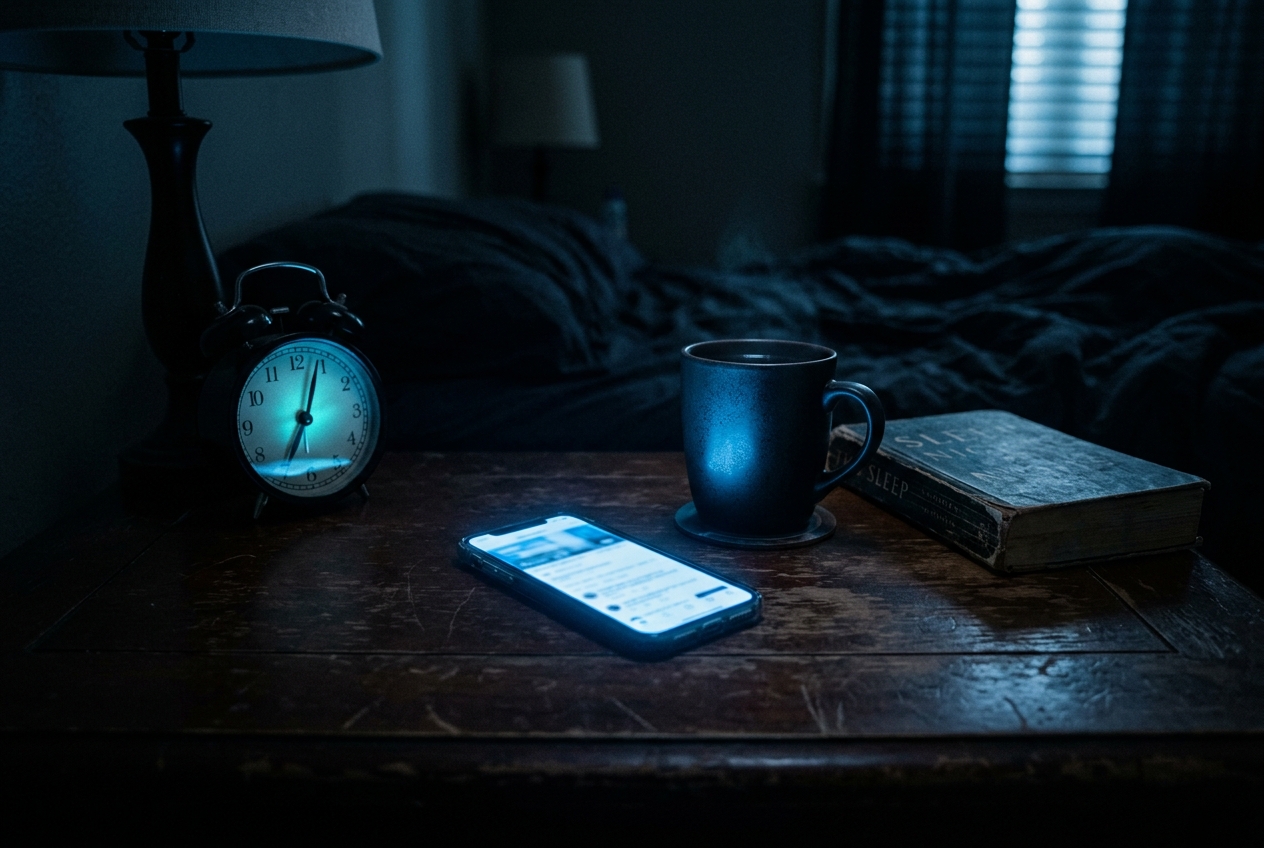
The costs of this arrangement are becoming clearer through a growing body of research, though it would be dishonest to claim the picture is yet complete or that causation is always cleanly separable from correlation. What the evidence does suggest, with reasonable consistency, is that heavy social media consumption is associated with disrupted sleep, reduced capacity for sustained attention, and elevated levels of anxiety and low mood, particularly in younger people. Sleep is perhaps the most concrete casualty: the blue light emitted by screens interferes with melatonin production, but the psychological arousal induced by distressing content is arguably a greater enemy of rest. A mind that has spent an hour absorbing accounts of catastrophe before bed is not easily persuaded that the night is safe.
Attention may be the subtler and more lasting cost. The capacity for deep, sustained, focused thought is not merely a professional convenience; it is, many philosophers and cognitive scientists would argue, central to what makes a reflective life possible at all. When the philosopher Simone Weil wrote about attention as a form of love, she was pointing toward something that goes beyond productivity. To attend fully to another person, to a problem, to a text, to the natural world, is an act of profound respect and engagement. Habitual scrolling trains the mind in the opposite direction: toward brevity, toward stimulation, toward the next thing before the present thing has been absorbed. This is not a trivial loss.
And yet, the response to all of this should not be shame, and it should not be the kind of fierce digital abstinence that treats the phone as an object of moral contamination. That framing tends to collapse under the weight of ordinary life, and it also misidentifies the problem. The difficulty is not that technology exists; it is that technology has been designed, by intelligent people with considerable resources, to maximise engagement in ways that do not always serve the interests of the person being engaged. Recognising this shifts the frame from personal weakness to structural design, which is both more accurate and more useful.
Practical steps exist, and they are more effective when they work with the grain of psychology rather than against it. Introducing friction, making the phone slightly harder to reach, removing apps from the home screen, keeping the device out of the bedroom, tends to reduce impulsive use without requiring iron willpower. Designating specific times for consuming news, rather than grazing continuously, allows the brain to process what it has taken in rather than accumulating an unmanageable residue of unresolved anxiety. Replacing the scroll with a brief deliberate activity, a walk, a few pages of a book, a conversation, does not require extraordinary discipline; it requires only a sufficient pause between impulse and action.
Perhaps the deepest question is not how to use our phones less, but what kind of attention we want to cultivate, and what kind of life that attention makes possible. Can we recover, in the midst of an environment engineered for distraction, the capacity to be genuinely present? And if we can, what might we find waiting there in the quietness we have been scrolling past?
BWGELA, in the spirit of OER, grants the Creative Commons Licence CC BY-NC-SA 4.0 to the reader, to include the attribution: ‘The Scroll Trap: Why Your Brain Cannot Stop Doom Scrolling’ scripted by the Pilgrim BWGELA @ www.bwgela.com 2026.