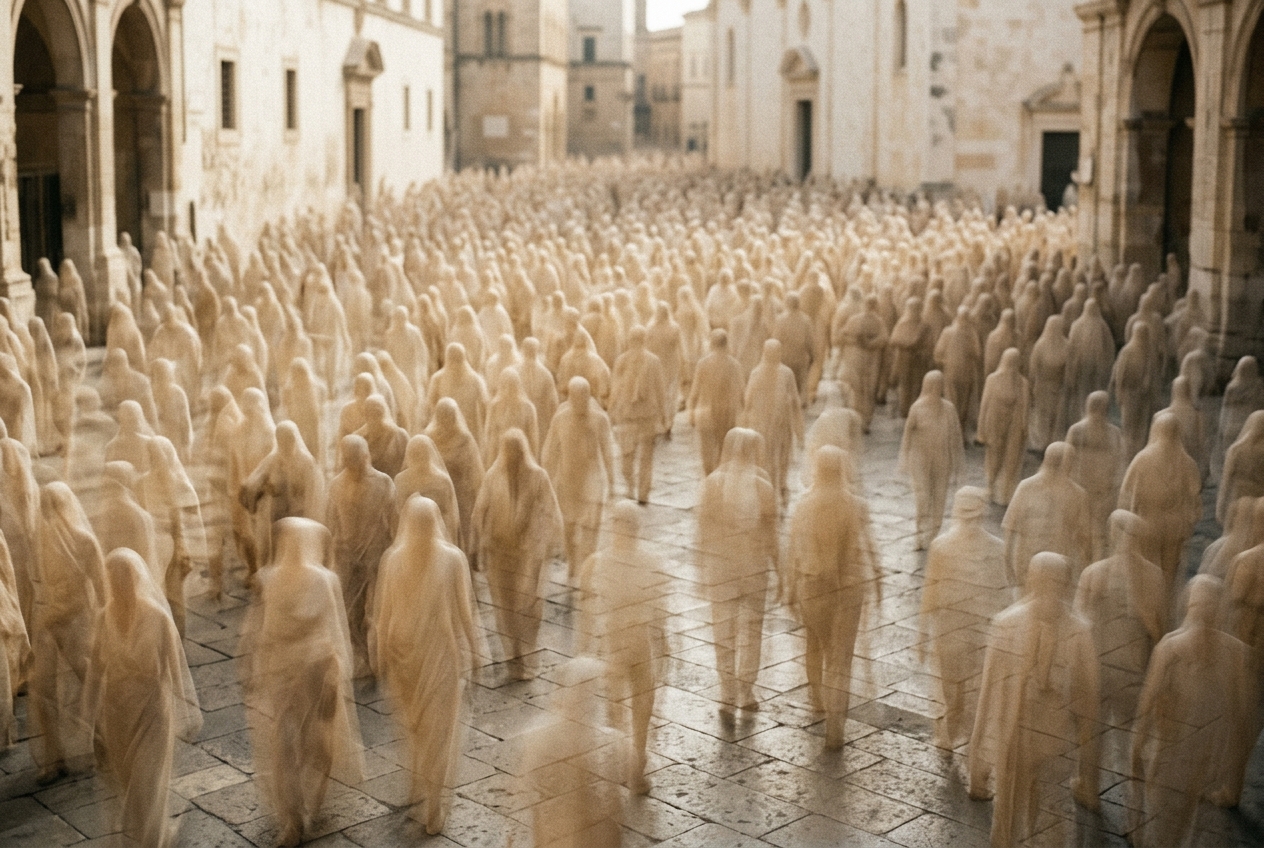
The Manufactured Consensus: AI, Elections and the Flooded Public Square
Written by The Pilgrim ·
What happens to democracy when the voices filling the public square are not human at all? Can we trust the appearance of popular feeling when that appearance can be manufactured at scale, cheaply, and without the consent of the people it claims to represent? These are not hypothetical anxieties reserved for dystopian fiction; they are live and urgent questions that every thoughtful citizen, every voter, every person who participates in public life must now sit with.
Democracy has always depended on a particular kind of trust. Not the naive trust that assumes every speaker is honest, but the provisional trust that assumes most voices in a conversation belong to real people with real stakes in the outcome. When a campaign leaflet arrives through the door, or a letter appears in a newspaper, or a crowd gathers in a town square, there is a background assumption that human beings, however biased or mistaken, are doing the speaking. That assumption is now under serious strain. Artificial intelligence tools can generate persuasive written content at a pace and volume that no human workforce could match, and they can do so for almost no cost. The public square, once crowded with imperfect but genuine human voices, can now be flooded.
The concept of a manufactured consensus is worth dwelling on carefully. A consensus, in the genuine sense, is something that emerges organically from the exchange of real opinions among real people over time. It is messy, slow, and often frustrating, because it requires actual minds to change and actual disagreements to be worked through. What artificial intelligence enables is something quite different: the simulation of consensus. Thousands of superficially distinct voices can be generated, each nudging a reader toward the same conclusion, each appearing to represent an independent point of view. The cumulative effect on a reader, or on an algorithm trained to measure sentiment, can be profound. What looks like widespread agreement may be the output of a single machine following a single instruction.
This is not merely a technical problem. It is a philosophical and civic one. Democratic legitimacy rests on the idea that the expressed will of the people reflects something real about what people actually believe. When that expression can be counterfeited, the entire architecture of consent begins to wobble. We are not speaking here of ordinary propaganda, which has always existed and which at least required human effort, human creativity, and some degree of human risk. We are speaking of something that scales effortlessly, that leaves no fingerprints, and that can be calibrated to exploit specific fears, grievances and hopes in specific communities at specific moments.
Critical thinking, then, becomes not a luxury of the educated or the intellectually inclined but a basic requirement of citizenship. The voter who encounters an apparently groundswell of opinion online needs the habits of mind to pause and ask: who is actually speaking here? What do I know about the source? Is the uniformity of this message a sign of genuine agreement, or a sign that the message has been industrially produced? These are the questions that rhetoric and philosophy have always taught us to ask of persuasive speech; what has changed is the urgency and the scale.
One of the more insidious aspects of this challenge is that manufactured content need not be obviously false to do its damage. A fabricated voice does not need to lie outright; it simply needs to amplify certain truths while suppressing others, to repeat certain framings until they feel inevitable, to make a minority position seem like a majority one until real people, wanting to belong, begin to adopt it themselves. Social proof is one of the most powerful forces in human decision-making, and the illusion of consensus exploits it with precision.
Institutions responsible for public discourse, whether media organisations, electoral commissions, schools or civic societies, face a genuine reckoning. The tools required to detect artificial content are improving, but they will never be infallible, and they will always lag behind the tools used to generate that content. No technology will solve this problem alone. What is required is a culture of scepticism, practised not as cynicism but as disciplined, generous, open-minded enquiry. The person who asks hard questions of a source is not being paranoid; they are doing exactly what democracy requires.
There is a real danger in over-relying on platforms or authorities to filter out the fabricated. That over-reliance is itself a form of the passivity that manufactured consensus tries to induce. If citizens outsource their judgement entirely, trusting that someone else has already verified what is real, they become exactly the kind of audience that is easiest to mislead. Vigilance cannot be delegated. It must be practised personally, at the moment of reading, viewing and deciding.
It is worth being clear about what artificial intelligence is in this context. It is a tool; a powerful, flexible and largely indifferent one. It does not care whether it serves honest democratic discourse or undermines it. The care must come from the humans who commission it, regulate it, teach others about it, and ultimately encounter its outputs as citizens. The machine does not bear responsibility. The people who deploy it do, and so do the people who consume its products without question.
Perhaps the deepest question raised by the flooded public square is one about the nature of political community itself. A healthy democracy is not merely a counting exercise; it is an ongoing conversation in which citizens genuinely encounter one another, genuinely contest ideas, and genuinely arrive at something shared. What is lost when the voices in that conversation are increasingly artificial? And how do we recover, or perhaps for the first time fully build, the habits of mind, the civic education, and the mutual trust that allow genuine encounter to happen even amid the noise? These questions do not have easy answers. But the willingness to keep asking them, carefully and without despair, may be the most democratic act available to us.
BWGELA, in the spirit of OER, grants the Creative Commons Licence CC BY-NC-SA 4.0 to the reader, to include the attribution: ‘The Manufactured Consensus: AI, Elections and the Flooded Public Square’ scripted by the Pilgrim BWGELA @ www.bwgela.com 2026.