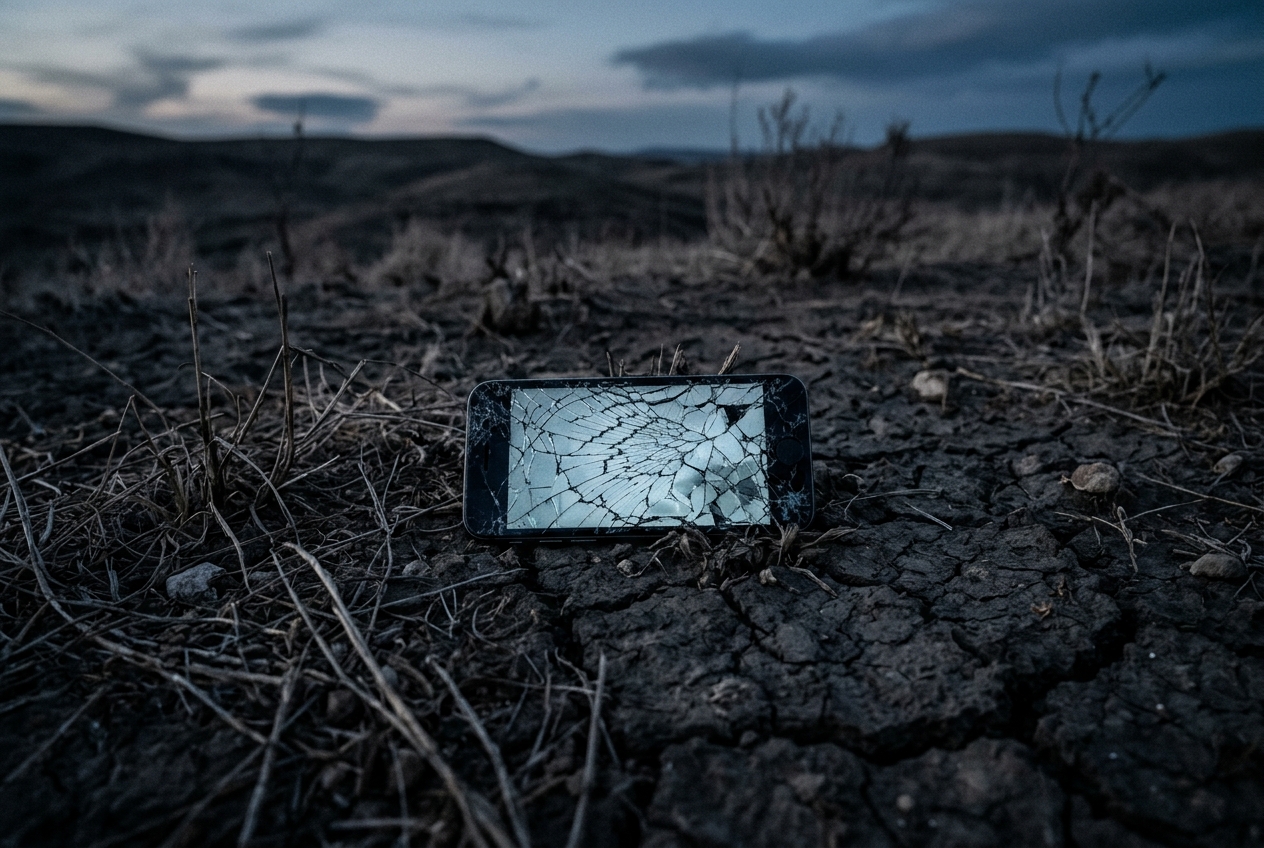
The Fragmented Lover: Finding Authentic Connection in a Desolated Digital Landscape
Written by The Pilgrim ·
Can we recognise love in an age of infinite choice? Where does authentic connection emerge when algorithms fragment our deepest human yearning into endless swiping? What would T. S. Eliot make of our contemporary romantic landscape?
One hundred years ago, in the aftermath of the First World War, the poet T. S. Eliot published a work that captured the spiritual exhaustion of the modern age. The Waste Land presented a fragmented world where meaning had collapsed, where communication had become mere noise, and where human connection seemed perpetually out of reach. The poem depicted lovers speaking past one another, words failing to bridge the chasms between people, and desire without genuine encounter. Yet Eliot was writing about a world without smartphones, without algorithmic sorting of potential partners, without the quantification and curation of human intimacy. One might reasonably wonder whether our current moment has transformed his metaphor into lived reality.
The parallel between Eliot total vision of fragmentation and contemporary digital dating culture is neither new nor trivial. When we enter a dating application, we are presented with a curated stream of human beings, each reduced to a handful of images, a biographical snippet, and a selection of interests. The technology promises efficiency, compatibility, scientific matching based on data and psychology. Yet what it actually delivers is a peculiar form of alienation that Eliot would have recognised immediately: the reduction of persons to profiles, of connection to swipes, of love to a transaction optimised by machine learning. The very tools designed to bring us together have fragmented the human encounter into its constituent parts, each separated from the others, each rendered consumable.
Consider what happens psychologically when we treat potential partners as items in an endless catalogue. The abundance of choice, paradoxically identified by psychologists such as Barry Schwartz, creates a paralysis of desire. Each person we encounter carries with them the implicit knowledge that infinitely many others remain available with a single gesture. This is not love; this is shopping. The algorithmic feed resembles less a meeting place and more a factory floor where human beings are sorted, graded, and passed along a conveyor belt. Swipe culture transforms romance into a numbers game where success is measured by matches, where rejection is instantaneous and consequence free, where the other person becomes almost irrelevant except insofar as they fulfil a checklist of predetermined criteria.
Eliot wrote of the difficulty of communication between lovers in his fragmented narrative voice. He showed us characters who desired one another yet could not speak truthfully, could not be heard, could not break through the barriers of ego and fear. Yet they were at least in the same room. They faced one another, however obliquely. In our current moment, we have eliminated even that minimal closeness. We can swipe away without ever encountering the vulnerability of another human being. We can compose and delete messages endlessly before sending them. We can curate our presentation so thoroughly that nothing genuine remains. The digital landscape promises intimacy but delivers only its simulation.
Yet to suggest that authentic connection has become impossible would be to miss something vital. Eliot himself, despite the apparent despair of The Waste Land, was not advocating for retreat into solipsism. Rather, he was diagnosing a malady in order that it might be recognised and, perhaps, healed. Similarly, we need not accept the fragmented landscape as our fate. Some people, remarkably, continue to find genuine connection within and despite digital platforms. They do so by resisting the logic of algorithmic matching, by refusing to treat the encounter as transactional, by approaching other people with curiosity rather than consumer impulse.
Authentic connection in the digital age emerges most readily when we consciously reject the technologies default modes of operation. This means being willing to spend time with someone who does not present as optimally matched on paper. It means having conversations that meander and digress, that go nowhere useful, that serve no purpose beyond the joy of mutual discovery. It means accepting boredom, awkwardness, and the possibility of genuine rejection, rather than the sterile pseudo rejection of being swiped left. It means recognising the other person as fundamentally unknowable, as exceeding any profile description, as worthy of attention precisely because they cannot be reduced to data.
Moreover, some of the most meaningful contemporary relationships begin precisely outside the algorithmic landscape. People continue to meet through friends, at universities, through work, through shared interests pursued in physical spaces. These encounters retain something of the old randomness, the productive accident, the sense of destiny that algorithms are designed to eliminate. When you meet someone through mutual friends, through circumstance, through what might be called luck, there is an implicit sense that this particular person matters, that the meeting was not inevitable but consequential.
There is also emerging evidence that intentionality matters. Research in relationship psychology suggests that couples who explicitly commit to depth, who resist constant comparison and novelty seeking, who invest in genuine knowledge of their partner, experience greater satisfaction and stability than those who treat relationships as optimisable experiences. This commitment is itself a form of resistance to the fragmented landscape. When we choose to build something with one person rather than keeping our options perpetually open, we are making a statement about what we value, about what love actually is.
Yet we must acknowledge that the challenge is real and structural. Dating applications are not going away. The logic of algorithmic optimisation is not going away. We live in a world where the technologies of fragmentation are embedded in every aspect of human connection. The solution is not naive withdrawal but conscious literacy, a deliberate cultivation of practices and values that push against the grain of algorithmic culture. This might mean spending less time on applications, more time in unpredictable encounter. It might mean choosing depth over breadth, commitment over optionality, mystery over complete information.
Eliot concluded The Waste Land not with despair but with fragments, with shattered images that nonetheless gesture toward redemption, toward the possibility of meaning beyond the waste. Similarly, we might view our moment not as one of inevitable alienation but as one of necessary choice. We can either surrender to the fragmented landscape and accept love as a consumer good, or we can resist, deliberately and repeatedly, finding authentic connection in the cracks and margins of digital culture, in the spaces where technology has not yet fully colonised human encounter.
So what can we conclude but this: that authentic connection in the digital age is neither impossible nor inevitable, but rather a matter of conscious choice and deliberate resistance to the default logics that surround us. We must recognise the fragmentation that technology offers and choose, again and again, to seek something more substantial, more human, and more true.
Questions to Ponder
- 1.
In what ways does your own use of dating technology shape your understanding of what authentic romantic connection actually means?
- 2.
How might the experience of abundance in choice fundamentally alter not just how we select partners, but our very capacity to commit to and love one person?
- 3.
If algorithms increasingly mediate how we encounter potential partners, do you believe genuine surprise or accident can still occur within these systems, and why?
- 4.
What social and cultural structures would need to change for people to value depth and uniqueness in relationships over the optimisation and variety that digital platforms encourage?
or to write private answers and keep them in My Journal.
BWGELA, in the spirit of OER, grants the Creative Commons Licence CC BY-NC-SA 4.0 to the reader, to include the attribution: ‘The Fragmented Lover: Finding Authentic Connection in a Desolated Digital Landscape’ scripted by the Pilgrim BWGELA @ www.bwgela.com 2026.