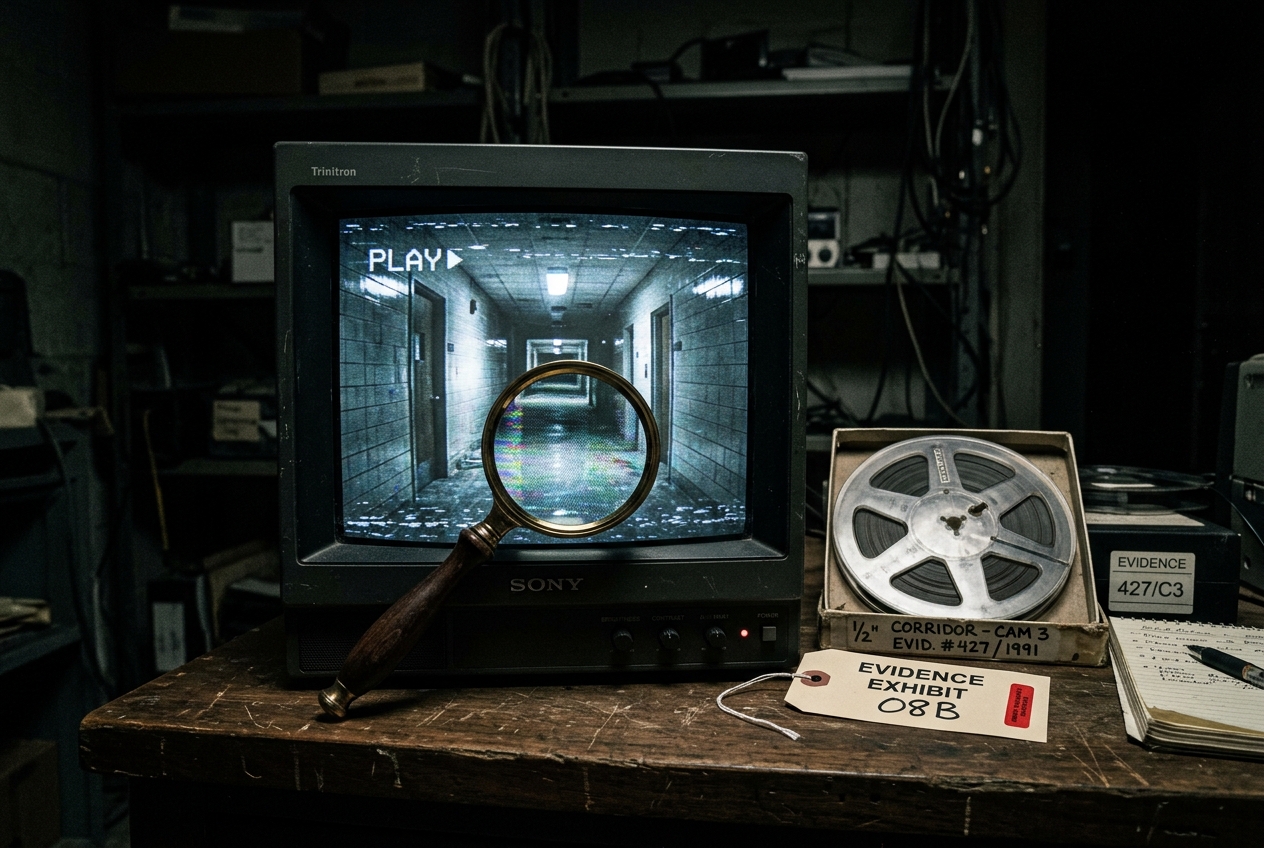
The Epistemic Forensics Challenge: Defending Digital Authenticity in a World of Deepfakes
Written by The Pilgrim ·
How do we know what we know from a screen? In an era when synthetic media can convincingly show the impossible, when deepfakes have become technically accessible and politically potent, the legal practitioner faces a peculiar epistemic predicament. The question is not merely whether a given video or image is authentic. The deeper challenge is how to interrogate digital evidence without descending into an indefensible scepticism that would paralyse justice itself. What does authenticity even mean when the technology of reproduction has become so sophisticated that certainty may be forever out of reach?
This is not a problem confined to high profile cases or celebrity deepfakes. In disclosure meetings, in tribunal bundles, in police stations and in chambers, lawyers encounter digital media daily. A WhatsApp message thread, a screenshot, a CCTV footage clip, a voice recording, a photograph allegedly taken at a particular time in a particular place. Each of these is vulnerable to manipulation, deletion, recontextualisation or simple misinterpretation. The stakes are real. Convictions rest upon them. Commercial disputes turn on their authenticity. Yet the practitioner cannot simply throw up their hands and declare all digital evidence suspect. The legal system requires decisions. It requires judgement calls about what can be relied upon and what cannot.
The temptation for the sceptical lawyer is to doubt everything. This posture has a certain intellectual appeal. It mirrors the rigour one might associate with scientific method. If we cannot be one hundred per cent certain that a video has not been manipulated, should we not exclude it? If we cannot definitively prove that a metadata timestamp is genuine, should we not reject the whole file? This is the path toward what might be called hyper scepticism. It masquerades as intellectual caution. In truth, it is epistemically self defeating. It forecloses the very inquiry that disciplined thinking demands.
Consider the forensic expert who sits in the witness box, having examined a digital file for signs of manipulation. The expert is trained to recognise certain indicators: compression artefacts inconsistent with the claimed format, metadata anomalies, temporal inconsistencies in pixel patterns, discontinuities that suggest splicing or synthesis. Yet even the honest expert must acknowledge profound limits. The technology of fake creation advances constantly. What looks suspicious today may become a known artefact of a new camera model tomorrow. What an algorithm identifies as probabilistically impossible may nonetheless be genuine. The expert cannot offer absolute certainty. They can only say that their examination revealed no evidence of tampering, or conversely, found indicators consistent with manipulation.
Here lies a crucial distinction that the law has been slow to fully internalise. Proving authenticity is not the same as proving authenticity is irrelevant to the case. A video may be genuine in the sense that it shows what it purports to show, and yet be of very limited probative value because it does not directly address the question in issue. Conversely, a video may be genuinely what it claims to be, yet intention, context and meaning remain contested. The forensic question and the legal question are not identical. The expert witness can address the former. The fact finder must ultimately address the latter.
This distinction becomes especially important when considering the phenomenon of what might be termed epistemic calibration. The reasonable practitioner does not seek binary certainty. Instead, they work with graduated confidence. They ask: what is the baseline level of authenticity I should expect for this type of material? What are the realistic error margins? What alternative explanations exist for the findings the expert presents? What would a contrary expert reasonably argue? In the context of a particular fact pattern, in a particular jurisdiction, with particular evidence standards, what threshold of doubt becomes reasonable doubt?
Thinking through this problem requires practitioners to resist two opposing errors. The first is naive credulity, the acceptance of digital media at face value simply because it is presented as evidence by a seemingly authoritative source. The second is the paralytic scepticism mentioned earlier, the view that nothing digital can ever be trustworthy. Between these poles lies the difficult terrain of epistemically responsible practice. It is here that the forensic lawyer must dwell.
One useful framework, drawn from recent work in epistemology and legal philosophy, distinguishes between authenticity and reliability. A document or media file may be authentic, in the sense that it is what it claims to be and has not been deliberately falsified, yet still unreliable as evidence of the proposition for which it is adduced. It may be genuine footage yet shot from an angle that misleads, or genuine audio yet recorded in circumstances that render the speaker unreliable. By the same token, something might be reliable for certain purposes even if its authenticity is subject to some residual doubt. The practitioner must learn to make these discriminations.
The threshold question, then, becomes: at what point does residual doubt about authenticity cross into inadmissibility or at least such serious weakness that reasonable fact finders could not rely upon it? This is not a metaphysical question. It is a pragmatic one, informed by the purpose of the evidence and the consequences of error. In criminal law, where the burden of proof is high and individual liberty is at stake, the threshold may reasonably be higher than in civil proceedings. In family law, where welfare of a child is paramount, the threshold may shift again based on the particular factual matrix. There is no universal answer, nor should there be.
What digital forensics teaches us, if we are willing to learn, is humility about our epistemic powers. The lawyer, even armed with the best expert evidence, operates within bounds of uncertainty. This is not a failure or a defect. It is the human condition. The legal system has always had to work with imperfect information, with testimony that might be mistaken or misremembered, with documents that might be misunderstood. Digital evidence is no different in kind, though it may be different in degree. The practitioner who accepts this insight is less likely to fall into either naive credulity or defensive scepticism.
The cultivation of what might be called epistemic vigilance is therefore essential. This means asking probing questions of experts about the limits of their methodology, about how they trained, about what they cannot rule out as easily as what they can. It means understanding enough about digital systems to know what questions to ask, even if one is not oneself a technician. It means resisting the temptation to treat expert evidence as oracle, whilst also recognising that expert evidence, properly tested and understood, remains invaluable. It means calibrating confidence appropriately to the stakes and the context.
Ultimately, the epistemic forensics challenge is not really about technology at all. It is about how thinking practitioners in law can maintain intellectual integrity whilst performing the practical function the legal system requires of them. It is about navigating between false certainties on one side and corrosive doubt on the other. It is about building judgement through careful practice, through learning from error, through engagement with genuine experts, and through sustained reflection on what we claim to know and why we believe we know it.
So what can we conclude? The digital age has not rendered the law epistemically helpless, nor should practitioners pretend it has. What it has done is sharpen the oldest challenge of legal practice: how to make sound judgements under uncertainty, with imperfect information, and bearing responsibility for real consequences. The lawyer who understands the limits of digital forensics, who can interrogate evidence without falling into nihilistic scepticism, who can calibrate confidence to context and purpose, is better equipped to serve justice than one who either credulous accepts or blanket rejects the digital world.
Questions to Ponder
- 1.
In your own practice, have you encountered a moment when you doubted digital evidence but lacked a principled reason to exclude it? What did you do?
- 2.
How might the distinction between authenticity and reliability change the way you cross examine a digital forensics expert in your next case?
- 3.
If your opponent presents a piece of digital evidence you suspect is manipulated but cannot definitively prove is false, what should your ethical obligation be?
- 4.
As courts become more dependent on digital evidence, what training and support do you think legal practitioners most urgently need to develop genuine epistemic competence?
or to write private answers and keep them in My Journal.
BWGELA, in the spirit of OER, grants the Creative Commons Licence CC BY-NC-SA 4.0 to the reader, to include the attribution: ‘The Epistemic Forensics Challenge: Defending Digital Authenticity in a World of Deepfakes’ scripted by the Pilgrim BWGELA @ www.bwgela.com 2026.