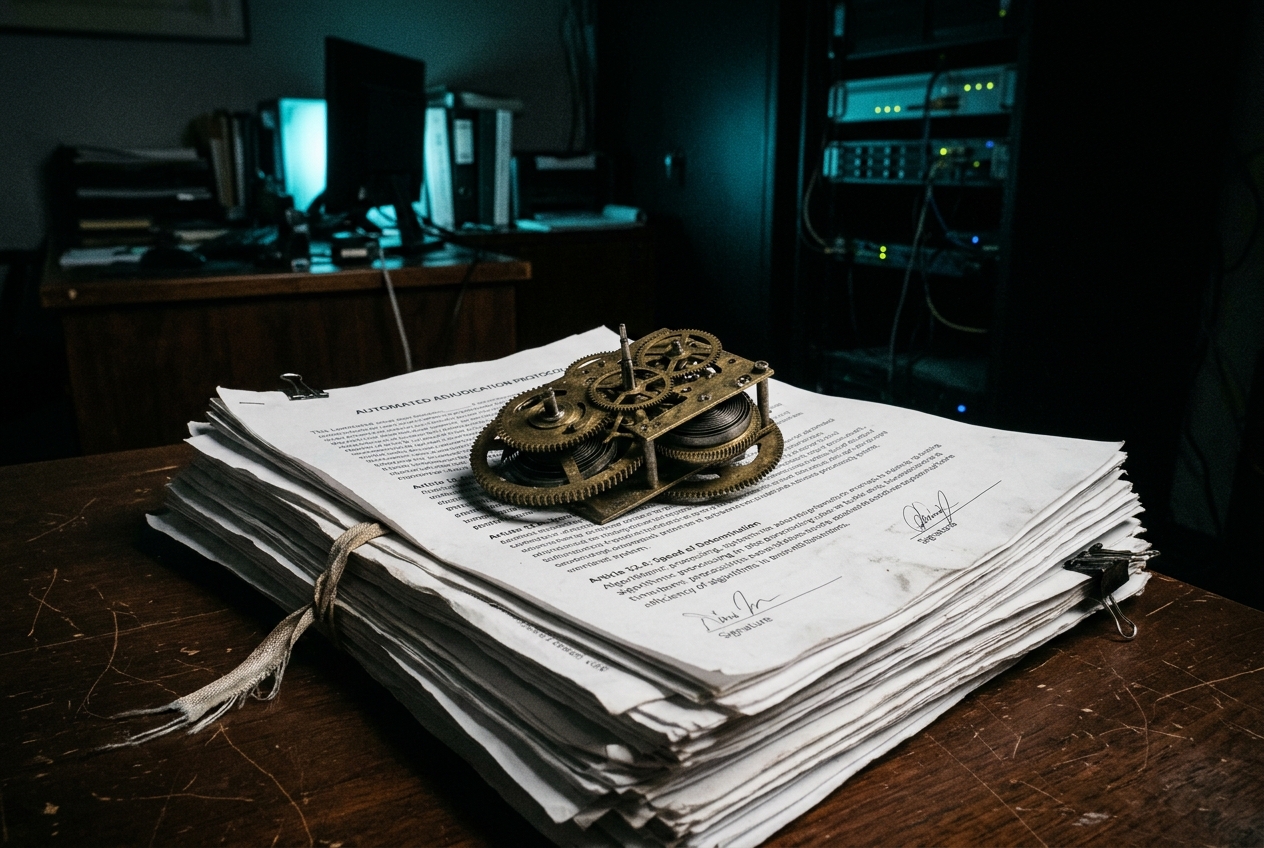
The Efficiency Trap: When Automated Legal Tech and Speed Strip Away Professional Nuance
Written by The Pilgrim ·
When did speed become the heartbeat of legal practice? Walk into most law firms today, and you will hear a familiar refrain: our new document review AI can process a million pages overnight, our contract analysis tool flags key terms in seconds, our legal research platform returns results before you have finished typing your query. The promise is seductive. Work faster, bill more, serve clients with unprecedented velocity. Yet beneath this promise lies a troubling question that lawyers of an earlier generation might have grasped more readily. What is lost when we optimise for speed above all else?
The rise of automated legal technology reflects a broader cultural conviction that efficiency is not merely a practical virtue but a moral one. This conviction runs deep in contemporary professional life. If a machine can do in ten minutes what took a human two hours, surely the human should step aside. Yet the lawyer who accepts this frame uncritically has already surrendered something essential to the craft. Consider the nature of legal work itself. A solicitor reviewing a contract is not simply cataloguing clauses; she is reading between lines, sensing tension in a counterparty's language, recognising what is not said as much as what is. An advocate preparing for trial is not just retrieving authorities; he is constructing a narrative, testing its weight against the facts, feeling where it might fracture. These are acts of human judgement that involve what the philosopher Gilbert Ryle distinguished as knowing how, not merely knowing that. An AI system can tell you that a particular principle of law exists. It cannot easily tell you how that principle will move a judge, how it will land in the particular context of your case, how it will feel to a jury.
Automation bias, the documented tendency of human beings to favour the output of automated systems over human reasoning, compounds the risk. Research in decision science has shown that when people see information presented by a computer, they are more likely to trust it uncritically, even when they would scrutinise the same information from a human source. A junior solicitor reviewing a contract with an AI tool overlay that highlights allegedly critical terms may unconsciously defer to the machine's judgement, skipping over sections the algorithm did not flag. She may not consciously realise she is doing so. The efficiency gain is real; the cost is a subtle erosion of professional attention.
Subscribe free to keep reading
Subscribe with your email to read every article, listen to the audio and use the libraries. Already a subscriber? Enter your email once on this device and everything opens.
No spam. No sales. No credit card.
By subscribing you agree to receive the BWGELA newsletter. You can unsubscribe at any time.
Have an account?
BWGELA, in the spirit of OER, grants the Creative Commons Licence CC BY-NC-SA 4.0 to the reader, to include the attribution: ‘The Efficiency Trap: When Automated Legal Tech and Speed Strip Away Professional Nuance’ scripted by the Pilgrim BWGELA @ www.bwgela.com 2026.