The Deepfake and the Doubt: When Seeing Is No Longer Believing
Written by The Pilgrim ·
What does it mean to trust your own eyes? And if that trust is no longer warranted, what becomes of the entire architecture of understanding we have built upon it? These are not merely technical questions for engineers or policy-makers; they are questions that reach into the very roots of how human beings make sense of the world, and they have become urgent in ways that earlier generations could scarcely have imagined.
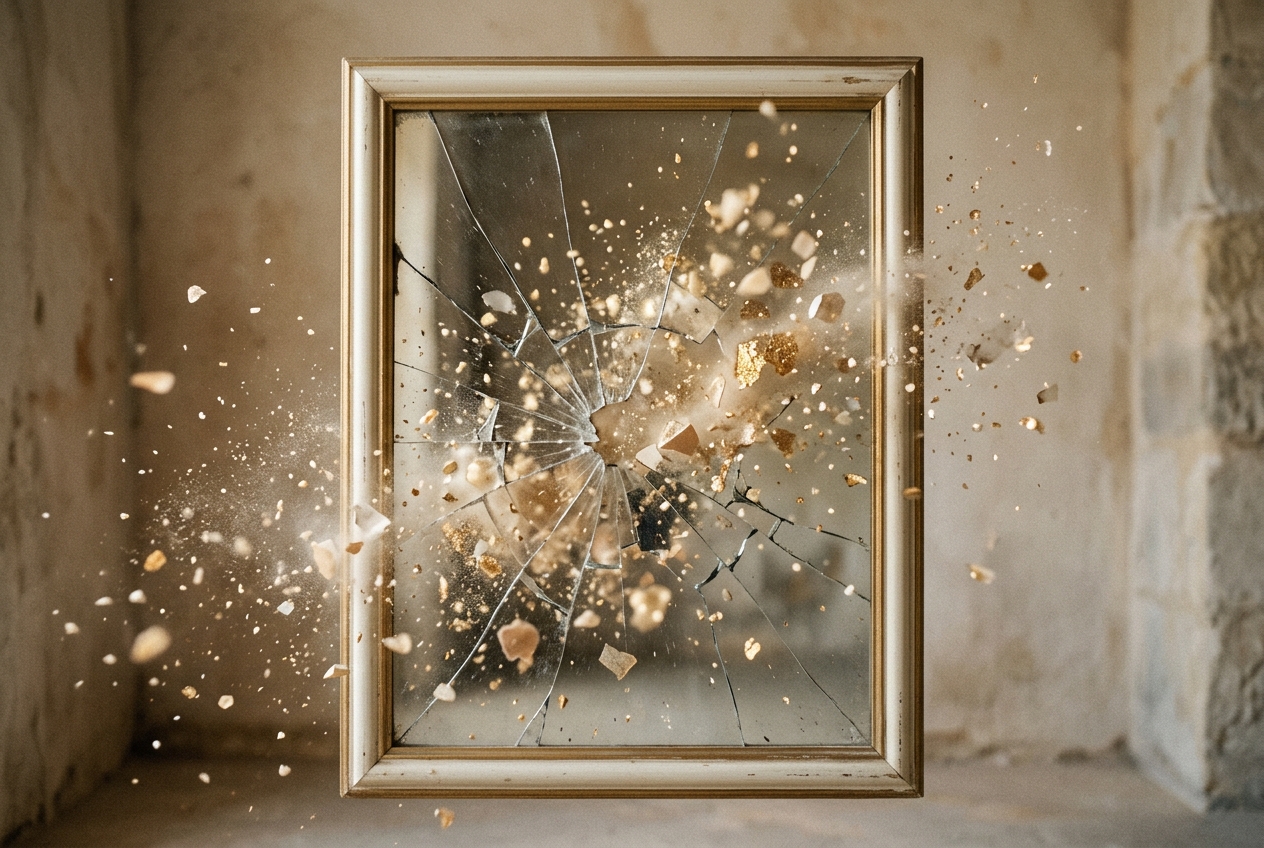
For most of recorded history, the image carried a particular authority. A photograph was not merely a representation but a trace, a record of light that had actually bounced from an actual surface at an actual moment in time. Even when photographs were cropped, staged or used tendentiously, the assumption was that something real had stood before the lens. That assumption was the bedrock upon which journalism, law, science and everyday social trust were partly built. The deepfake does not merely challenge one photograph or one recording; it dissolves the bedrock itself.
Synthetic media, produced through deep-learning systems trained on vast quantities of genuine footage, can now render a person saying something they never said, doing something they never did, with a fidelity that defeats the casual observer entirely. The voice, the micro-expressions, the ambient lighting, the characteristic tilt of a head: all of it can be fabricated. What we are confronting is not a new kind of lie but a new kind of falseness, one that operates at the level of evidence rather than argument. A lie in words can be contested with other words; a fabricated image attacks the very faculty we have historically used to settle such contests.
The philosopher who thinks carefully about knowledge will recognise this as an epistemic crisis in the precise sense. Epistemology concerns itself with the conditions under which we can be said to know something, and one of those conditions has traditionally been reliable perception. If our perceptual reports can be systematically deceived not by the limitations of our own senses but by the deliberate craft of another agent, then a foundational condition for knowledge is compromised. We are not simply mistaken; we are rendered structurally vulnerable to being made mistaken, at scale, by those with the motivation and the means.
The consequences fan outward in troubling directions. Consider the political realm, where the currency of accountability has always depended upon documented evidence. A recording of a public figure making a damaging admission once carried enormous weight. Now, any such recording must labour under the shadow of possible fabrication. And here lies one of the deepest perversities of the situation: the genuine becomes as suspect as the false. A politician caught in genuine wrongdoing can dismiss authentic evidence as a deepfake, and the dismissal now carries a plausibility it would not have carried a decade ago. The technology does not merely enable new deceptions; it provides a universal alibi for the already deceitful.
This is what scholars of information sometimes call the liar dividend: the advantage that accrues to bad actors not because they produce false material but because they can cast doubt upon true material. In a world where fabrication is possible, deniability expands to fill the available space. The erosion of trust in evidence does not produce a cautious, deliberate public, pausing to verify before forming judgements; it tends instead to produce a cynical one, inclined to disbelieve everything or to believe only what already confirms existing conviction. Scepticism, which ought to be a disciplined tool of reason, becomes instead a reflex of exhaustion.
How, then, do we preserve discernment in such conditions? The first and perhaps most important response is to resist the temptation of simple technical solutions. Detection algorithms already exist and will no doubt improve; but every improvement in detection tends to be met by improvement in generation, since the same adversarial logic that trains one system trains the other. The arms race is real, and we should not stake the coherence of our epistemic culture on winning it decisively. Detection tools are aids to judgement, not substitutes for it.
What we need, more urgently, is a renewed literacy in the practices of reasoning under uncertainty. This is not a new idea; it is, in many respects, the oldest idea in the tradition of critical thinking. Long before deepfakes, juries were asked to weigh competing testimonies, scientists were asked to assess the reliability of data, and readers were asked to evaluate the credibility of sources. The question was always not whether evidence is certain, which it rarely is, but whether it is sufficient, coherent, independently corroborated, and free from obvious motivation to deceive. These questions remain the right questions; they simply need to be applied more consciously and more widely.
There is also something to be said for the cultivation of what we might call forensic patience: the willingness to suspend conclusion rather than rush to it, to sit with uncertainty rather than resolve it prematurely in either direction. This is uncomfortable, because the mind craves resolution and the media environment rewards speed. But the discomfort of not knowing is, in this context, a sign of intellectual honesty, and intellectual honesty is precisely what synthetic media is designed to defeat.
Communities of trust matter enormously here. We have long relied on intermediary institutions, journalists, courts, scientific bodies, to do some of the verification work on our behalf, and we have trusted those institutions to the degree that we found them credible. The weakening of such institutions, which precedes the deepfake crisis but is now exacerbated by it, leaves individuals exposed in ways they are not equipped to manage alone. Rebuilding those institutions, or building new ones adequate to the present moment, is not a task for technology alone; it is a task for the social and political will of a society that still believes discernment matters.
Can we hold on to that belief? Can we maintain the discipline of judgement even as the very materials of judgement are rendered unstable? These are the questions on which a great deal depends, and they are, for now, genuinely open.
BWGELA, in the spirit of OER, grants the Creative Commons Licence CC BY-NC-SA 4.0 to the reader, to include the attribution: ‘The Deepfake and the Doubt: When Seeing Is No Longer Believing’ scripted by the Pilgrim BWGELA @ www.bwgela.com 2026.