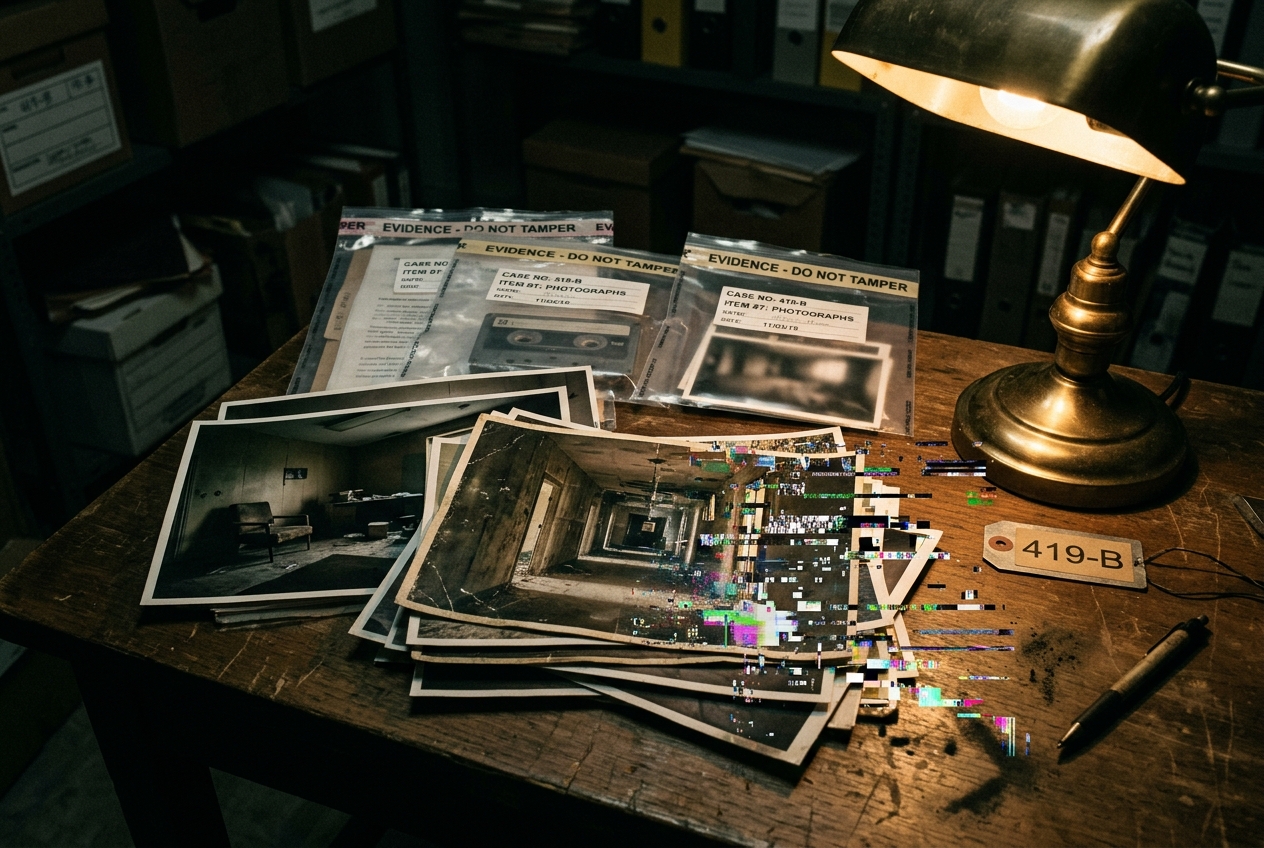
The Death of Veridical Bias: How Synthetic Evidence is Rewriting the Rules of Discovery
Written by The Pilgrim ·
What does it mean to trust evidence when the camera no longer lies but merely misleads? How should lawyers practise disclosure when the distinction between genuine and synthetic becomes experimentally uncertain? And what happens to the law when veridical bias, that ancient human instinct to believe our eyes and ears, collapses beneath the weight of synthetic media?
For centuries, the photograph held a peculiar power in law. It was the witness that could not equivocate, the medium that seemed to capture objective reality. Audio recordings carried similar weight: here was the actual voice, the precise words, untransmuted by memory or interpretation. This deep human bias toward visual and auditory evidence, what we might call veridical bias, became foundational to disclosure practice, to cross examination, to the whole architecture of fact finding. A solicitor reviewing disclosed materials would encounter a video or photograph and experience an almost intuitive sense of having encountered truth. The image seemed to speak for itself. Yet that intuition rested on an unstated assumption: that the technology of capture was honest, that the chain of custody was unbroken, and that human perceptual apparatus, evolved to detect deception in face to face encounters, remained reliable. All three assumptions are now in question.
The emergence of synthetic media, deepfakes, voice cloning and face swapping technologies has introduced a radical doubt into legal practice. These tools are no longer crude or obviously artificial. Recent research into generative adversarial networks and diffusion models suggests that even expert observers struggle to distinguish genuine from synthetic footage with confidence above random chance. A barrister reviewing a video deposition might genuinely wonder: is this the recorded voice of the witness, or a synthetic rendering? Is the facial expression authentic, or algorithmically interpolated? The question is no longer academic. It has moved into chambers, into disclosure reviews, into the preparation of bundles and the framing of evidence statements.
Consider the practical implications for disclosure. The Civil Procedure Rules place obligations on parties to disclose documents that are relevant to the case. That framework assumes a relatively stable understanding of what documents are and what they contain. But if a party provides video evidence, how should the receiving solicitor verify its authenticity? Chain of custody, the traditional answer, becomes inadequate when synthesis happens at the point of capture. A deepfake can be created in a way that mimics every conventional indicator of provenance. The metadata can be falsified. The compression signatures can be simulated. The very notion of chain of custody presumes that evidence exists as a stable artefact that moves from hand to hand. Synthetic evidence challenges this assumption. It may exist only as a file, capable of infinite reproduction, verification impossible without recourse to technological expertise that the average legal practitioner does not possess.
This uncertainty generates what some commentators term the liar is dividend: the perverse incentive structure wherein genuine evidence can be dismissed as fake merely because synthetic alternatives now exist. A witness provides authentic video footage of events. The opposing party, acting in bad faith, claims it is synthetic. The burden of proof shifts. Suddenly the party with genuine evidence must expend resources to demonstrate authenticity, whilst the sceptic bears no corresponding burden. Legal systems built on the assumption that evidence speaks clearly now find themselves entangled in epistemological mud. How does a barrister cross examine a video when its authenticity itself is disputed? Does the cross examination address the events recorded, or first the question of whether recording occurred at all?
The problem deepens when we consider the nature of proof itself. Common law systems evolved adversarial procedures predicated on the idea that truth emerges through contest. Barristers challenge witnesses, test their recollection, expose inconsistencies. The system functions because human beings, for all their frailty, remain identifiable as sources of knowledge or falsehood. Cross examination can reveal nervous habits, evasion, rehearsed language. These human markers of credibility become less accessible when the evidence is synthetic. You cannot cross examine an algorithm. You cannot appeal to conscience or fear of perjury. The very structure of adversarial testing breaks down when applied to media whose authenticity is uncertain.
Those advising in tribunal hearings or appellate courts now face a peculiar predicament. The judge or tribunal member arrives in the hearing room carrying the same veridical bias that has governed legal practice for generations. They too have been socialised to trust visual and auditory evidence. Yet counsel has a professional duty to draw attention to the possibility of synthesis, to cast doubt, to require proof of authenticity. This creates a tension between professional responsibility and the realistic assessment of how fact finding actually works. If counsel introduces the possibility of synthetic manipulation, does this serve the interests of justice or merely muddy the waters? If counsel remains silent about this possibility, have they fulfilled their duty of candour to the court?
Some jurisdictions are beginning to address these questions through evidentiary guidance and procedural rules. Organisations devoted to legal practice now publish frameworks for assessing digital evidence, emphasising the importance of forensic analysis, metadata verification, and expert evidence about authenticity. Yet these approaches remain reactive. They treat synthetic media as an exceptional problem, something that arises occasionally and can be managed through additional scrutiny. But if the technology becomes sufficiently widespread and accessible, if synthesis becomes a default expectation rather than an anomaly, the entire edifice of disclosure and trial practice may require rethinking. We cannot forever rely on legal practitioners discovering forensic expertise about spectrographic analysis or neural network detection methods. That path leads to trials becoming impenetrable to those without technical background, a democratically troubling outcome.
There is also the question of institutional trust. Law depends not only on the quality of individual judgements but on the perceived legitimacy of institutions. If the public observes that video evidence can be fabricated, that audio can be cloned, and that legal systems struggle to distinguish genuine from synthetic, confidence in the courts erodes. The veridical bias that once worked to support legal authority now becomes a vulnerability. If people assume that evidence cannot be trusted, they lose faith in the very system designed to resolve their disputes.
What role should philosophers of epistemology play in this conversation? Legal practitioners often regard philosophy as abstract and impractical. Yet the crisis of synthetic evidence is fundamentally epistemological. It asks: how do we know what we know? On what grounds can we assert that something is true about the world? These are not merely theoretical concerns. They restructure the practical work of disclosure, of cross examination, of judgement. A solicitor reviewing a video bundle is engaging in an act of knowledge production. If the grounds for that knowledge have shifted, the practitioner needs conceptual resources to think through what has changed.
The path forward is unlikely to be purely technological. We might develop better detection methods for synthetic media, but the technology of fabrication will advance in parallel. Instead, the response must be institutional, procedural and epistemological. It means revising disclosure obligations to account for digital uncertainty. It means training lawyers to recognise the limits of their own perceptual judgement and to seek expert assistance appropriately. It means developing new evidentiary standards that account for the possibility of synthesis without becoming paralysed by scepticism. Above all, it means recognising that veridical bias, for all its historical utility, can no longer be treated as an unexamined default.
So what can we conclude? The death of veridical bias does not mean the death of evidence or judgement. Rather, it marks a threshold moment in legal practice where lawyers must become conscious of what was previously intuitive, must develop new habits of epistemological caution, and must reconstruct the procedures of discovery and fact finding on foundations that acknowledge the synthetic character of modern evidence. This is not a crisis to be solved through technology alone, but a call to deeper reflection on how law creates knowledge and how we can sustain trust in that process when the medium can no longer be presumed to be the message.
Questions to Ponder
- 1.
When you review video evidence in a case, what specific techniques do you currently use to verify its authenticity, and are those methods sufficient if synthesis becomes commonplace?
- 2.
How should the professional duty of candour to the court evolve when counsel must now question not just the interpretation of evidence but the evidence is reality itself?
- 3.
If the burden of proving authenticity shifts to the party providing genuine evidence, how does this fundamentally alter the adversarial balance that common law procedure assumes?
- 4.
What institutional reforms would be needed to maintain public confidence in the courts when evidence itself becomes epistemologically uncertain and verifiable only through expert technical analysis?
or to write private answers and keep them in My Journal.
BWGELA, in the spirit of OER, grants the Creative Commons Licence CC BY-NC-SA 4.0 to the reader, to include the attribution: ‘The Death of Veridical Bias: How Synthetic Evidence is Rewriting the Rules of Discovery’ scripted by the Pilgrim BWGELA @ www.bwgela.com 2026.