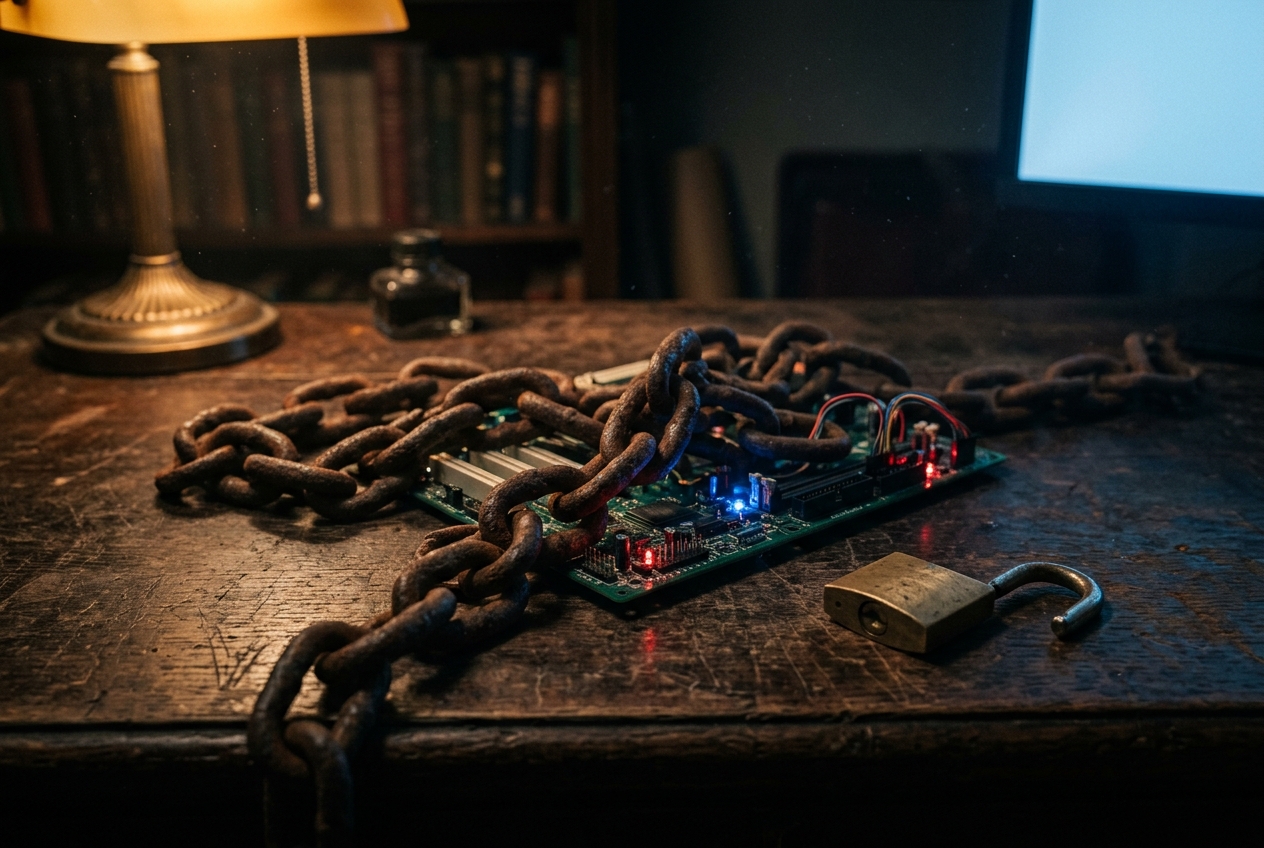
The Darker Use: AI, Exploitation and the Trafficking of the Vulnerable
Written by The Pilgrim ·
What happens when the most powerful tools ever built are placed in hands that seek not to help but to harm? And when the vulnerable are the ones who pay the price, what does that tell us about the moral character of the age that built those tools in the first place?
There is a tendency, when we discuss artificial intelligence, to frame the conversation around potential: the diseases it might cure, the efficiencies it might unlock, the creative possibilities it might open. This is understandable. Human beings are drawn to the horizon, and the horizon that AI presents is genuinely vast. But there is another landscape, darker and more immediate, that we are sometimes reluctant to examine with the same rigour. It is the landscape in which AI is not a tool of liberation but of predation, not a means of connection but of calculated exploitation. To look away from that landscape is not optimism; it is a failure of moral seriousness.
Consider first the relatively familiar terrain of scams and financial manipulation. AI has made it possible for those who wish to deceive others to do so at a scale, a speed and a level of personalisation that was simply not available before. The fraudulent message that once arrived in clumsy, broken language, easily identified and dismissed, now arrives polished, contextually aware and emotionally attuned. It knows the name of the recipient, the name of their bank, perhaps the rough details of a recent transaction. It mimics the voice or the image of a trusted figure with a fidelity that would have seemed impossible a decade ago. Older people, people in financial distress, people who are isolated or grieving, find themselves in correspondence with what appears to be a concerned bank official, a sympathetic friend, or even a deceased loved one rendered in digital approximation. The psychological violence of this is not a side effect; it is the mechanism.
But scams, as harrowing as they are, represent only one register of harm. Further along the spectrum of exploitation lies something considerably graver: the use of AI technologies in the facilitation of trafficking and the abuse of the most vulnerable members of society. This is not a speculative concern. Researchers and law enforcement organisations across the world have documented the ways in which AI-enabled tools are being woven into the infrastructure of modern trafficking. Recruitment, the first and most critical phase of trafficking, has been transformed. Automated systems can generate thousands of false job advertisements, tailor them to the economic anxieties of specific communities, translate them fluently into dozens of languages and post them across platforms faster than human moderators can remove them. The person who responds to what appears to be a genuine opportunity for work abroad may, within days, find themselves in a situation of profound danger.
Deepfake technology introduces a further layer of horror. Abusers have used it to fabricate intimate imagery of real individuals, using those fabrications as instruments of coercion and control. A person can be shown an image of themselves, real in appearance but entirely manufactured, and told that the image will be shared with family, employers or communities unless compliance is forthcoming. This is blackmail refined to a point of almost surgical cruelty, and its victims are disproportionately young, often adolescent, and already in positions of social fragility.
We should also attend to the use of AI in the management and concealment of trafficking networks themselves. Encrypted communications platforms, route-planning tools, AI-generated documentation: these are not futuristic scenarios but present realities that investigators working in this field encounter regularly. The same logistical intelligence that helps a legitimate business optimise its supply chain can help a criminal network move people across borders with reduced risk of detection. Technology does not choose its users, and it does not discriminate between the moral character of the purposes to which it is put.
What is the right response to all of this? One answer, the instinctive one, is regulatory: build better filters, mandate greater transparency, require platforms to do more. These are not wrong answers, but they are incomplete. Regulation operates on a lag, always chasing a problem that has already evolved. And those who wish to exploit AI for harmful ends are not constrained by the slow movement of legislative bodies. They adapt quickly, resourcefully and without ethical friction.
A deeper response requires us to think about what we mean by moral vigilance in an age of powerful, dual-use technology. Moral vigilance is not the same as moral panic. It does not mean refusing to engage with AI or treating every new capability as inherently sinister. It means maintaining a continuous, disciplined awareness that capability and conscience are not the same thing, that a tool which can do extraordinary good can, in other hands or even in the same hands, do extraordinary harm. It means asking, at every stage of development and deployment, who is made more vulnerable by this, and what protections exist for them.
It also means refusing to allow the discourse around AI to be dominated entirely by those with a commercial interest in its adoption. The voices of survivors of trafficking, of people who have been deceived and manipulated by AI-assisted fraud, of communities that have been targeted precisely because of their economic or social precarity: these voices belong at the centre of any serious ethical reckoning with the technology. They are not edge cases. They are the human cost written plainly.
Perhaps the most unsettling question is not whether AI will be misused. It already is, systematically and at scale. The more pressing question is whether we, as a society, have the moral seriousness to look at that reality without flinching, to centre the most harmed rather than the most powerful, and to ask ourselves what kind of stewardship of transformative technology is actually worthy of the name. What would it mean to build a world in which the power of these tools flows toward the vulnerable rather than against them? And are we, honestly, trying?
BWGELA, in the spirit of OER, grants the Creative Commons Licence CC BY-NC-SA 4.0 to the reader, to include the attribution: ‘The Darker Use: AI, Exploitation and the Trafficking of the Vulnerable’ scripted by the Pilgrim BWGELA @ www.bwgela.com 2026.