Surveillance, Suspicion, and AI: How Hyper-Visibility Is Redefining Relationship Jealousy
Written by The Pilgrim ·
When your partner is tracked by algorithm and their every move is logged, does technology forge trust or merely create the illusion of knowing someone we fear we cannot trust? Have we entered an age where visibility has become a substitute for faith? And if we can see everything, why do we feel we understand nothing?
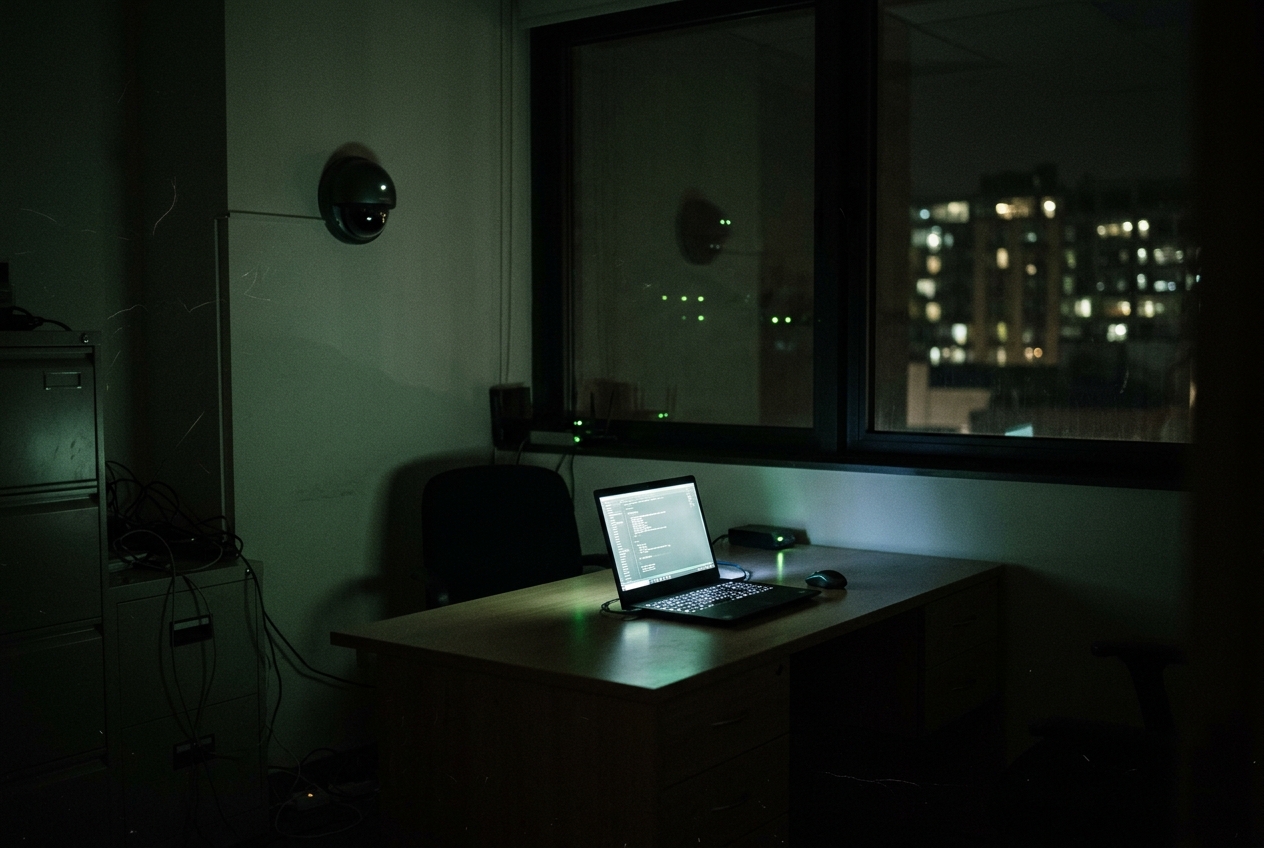
The digital age has granted us a peculiar gift. We can now track our partners in real time. Location apps ping their position on a map. Social media timestamps their activities. Messaging platforms log their online status and read receipts. Financial apps reveal their purchases. Fitness trackers broadcast their movements and heart rates. This hyper-visibility was meant to be reassuring, a technological answer to the ancient human anxiety of absence. Yet something has inverted. The more we can see, the more suspicious we become. The surveillance meant to build trust has instead become the architecture of paranoia.
Jeremy Bentham, the eighteenth-century utilitarian philosopher, conceived of the panopticon as a prison in which a single guard in a central tower could observe all inmates without the inmates knowing whether they were being watched. The genius of the design, Bentham argued, was that the mere possibility of being watched would make people behave as though they were constantly surveilled. The prisoners would internalise the gaze. Michel Foucault later took this image and applied it to modern life more broadly, suggesting that contemporary society functions as a panopticon where surveillance is everywhere and nowhere. We have become guards and prisoners simultaneously.
But romantic relationships have always been, in some sense, domestic panopticons. One partner watches for signs of infidelity. The other studies behaviour for indications of waning affection. Yet the traditional panopticon relied on interpretation, on reading between the lines, on trusting one another enough to not constantly monitor. The digital panopticon is different. It provides data. It offers certainty, or the promise of it. And certainty, it turns out, may be more dangerous to intimacy than doubt ever was.
Consider the Shakespearean tragedy of jealousy, wherein a man is driven to madness not by evidence of betrayal but by the mere suggestion of it, by seemingly innocent signals misread through the lens of suspicion. The tragic figure becomes convinced that his partner is unfaithful, and though he gathers circumstantial evidence, he can never quite satisfy himself that he has the whole truth. His jealousy is not calmed by what he sees; it is inflamed by what he cannot see. What he cannot account for. Today we have the tools to account for everything. And yet the jealousy remains.
An algorithmic tracking app can tell you where someone is, but it cannot tell you why. It can show you their location at two in the morning, but it cannot show you their intentions. It can log a notification from an unknown contact, but it cannot reveal the nature of the conversation. This gap between visibility and understanding is where modern jealousy lives. We have more data than ever before, yet we seem to have less clarity about what it means. The hyper-visibility does not resolve suspicion; it generates new categories of suspicion. The absence of a notification becomes suspicious. The pattern of online status updates becomes suspicious. The absence of a check-in becomes suspicious.
There is a crucial distinction between trust and verification. Trust is the decision to believe in someone despite uncertainty. It is a choice made without complete information. Verification, by contrast, is the elimination of uncertainty through evidence. These two modes of relating seem like they should reinforce one another, but they often do not. The more we verify, the more we need to verify. Each answer generates new questions. Each piece of data authenticated requires us to authenticate the next piece. The process becomes recursive and endless. We mistake the accumulation of evidence for the establishment of truth.
Psychologist Harriet Braiker, in her research on relationship dynamics, noted that excessive monitoring and surveillance often correlate with relationship insecurity rather than resolve it. Partners who invested heavily in surveillance tools reported higher levels of anxiety, not lower. The tools did not eliminate doubt; they created a feedback loop where doubt justified monitoring, and monitoring generated new reasons for doubt. This is not a failure of technology per se. This is what happens when we ask technology to do the work that only trust can do.
The algorithmic dimension adds another layer to this problem. We are now not just watching our partners; we are entrusting our watching to algorithms. These systems are designed to predict behaviour, to flag anomalies, to alert us to patterns we might not consciously notice. We are outsourcing our suspicion to mathematics. The algorithm becomes a third party in the relationship, a jealous oracle that speaks in data visualisations and notifications. It watches with an inhuman constancy. It forgets nothing. It associates and correlates with a speed and precision no human mind can match. And yet it understands nothing.
There is also an asymmetry worth considering. In most relationships where surveillance technology is deployed, one partner knows they are being watched while believing they have nothing to hide. The other partner may not fully grasp the extent of the monitoring. Or one partner may interpret surveillance as a sign of commitment and devotion, proof that the other cares enough to know their movements, whilst the watched partner experiences it as a cage. These different interpretations of the same behaviour can mask deeper fractures in how two people understand their bond.
Perhaps the central question is not whether we should use these tools but what using them says about the relationship itself. If we feel we need to track someone to trust them, perhaps the real issue is that we do not trust them. And if we do not trust them, surveillance will not create trust; it will only create an elaborate performance of transparency. Both partners will know at some level that the visibility is conditional, temporary, revocable. The watched partner may comply outwardly whilst experiencing the relationship as oppressive. The watching partner may find the data comforting until the moment they do not, when a single piece of evidence contradicts the narrative they have constructed.
We might usefully recall that the panopticon, for all its theoretical power, never actually achieved what Bentham hoped. Prisoners found ways to hide. Guards grew inattentive. The perfection of surveillance turned out to be impossible. Similarly, the dream of total transparency in romantic relationships is a dream of something that cannot exist. There will always be an inner life, a private consciousness that no app can access. There will always be moments that no algorithm can predict. The attempt to eliminate all possibility of betrayal through hyper-visibility does not make relationships safer. It makes them lonelier.
So what can we conclude: that technology has redefined the vocabulary of jealousy without resolving its ancient roots. We now possess the ability to see more than ever before, yet this abundance of information often leaves us feeling less certain, more anxious, more convinced that we are being deceived precisely because we have such comprehensive evidence that we are not. The green-eyed monster has not been tamed by the algorithm. It has simply learned to speak in data and to hide behind the promise of certainty. Trust, by contrast, remains an act of faith, and faith cannot be verified.
Questions to Ponder
- 1.
If surveillance technology can show us what our partner does but never why they do it, what kind of knowledge are we actually gaining, and does more data necessarily mean deeper understanding?
- 2.
When we monitor a partner to ensure fidelity, are we protecting the relationship or revealing that we have already lost the trust that makes the relationship worth protecting?
- 3.
How might widespread use of relationship surveillance apps reshape what we collectively believe a healthy partnership should look like, particularly for younger people forming their first attachments?
- 4.
If society increasingly expects transparency through tracking in intimate relationships, what psychological and social costs might we incur when privacy becomes equated with deception?
or to write private answers and keep them in My Journal.
BWGELA, in the spirit of OER, grants the Creative Commons Licence CC BY-NC-SA 4.0 to the reader, to include the attribution: ‘Surveillance, Suspicion, and AI: How Hyper-Visibility Is Redefining Relationship Jealousy’ scripted by the Pilgrim BWGELA @ www.bwgela.com 2026.