Owning the Space: Movement, Stance and the Silent Language of the Stage
Written by The Pilgrim ·
The speaker arrives at the lectern and immediately begins to shift weight from one foot to the other. The audience notices this before registering a single word. Within seconds, the space between speaker and listener has been subtly contaminated by nervous energy, and the message of authority has been undermined by the message of doubt. This is the paradox that every public speaker must confront: the body speaks louder than rhetoric, and what we do with our physical presence either amplifies our message or dilutes it beyond recovery.
Consider how you stand. Grounding yourself means distributing your weight evenly across both feet, with your shoulders relaxed and your spine naturally straight without rigidity. This stance creates a psychological anchor. When you feel unstable, you become unstable, and your audience senses this immediately. The human brain is exquisitely attuned to detecting incongruence between words and bodily signals. A speaker might declare confidence while their knees lock or their frame hunches inward, and the listener will unconsciously trust the body more than the voice. This is not because we are cynical by nature, but because bodily behaviour is harder to fake. It reveals the truth beneath the performance.
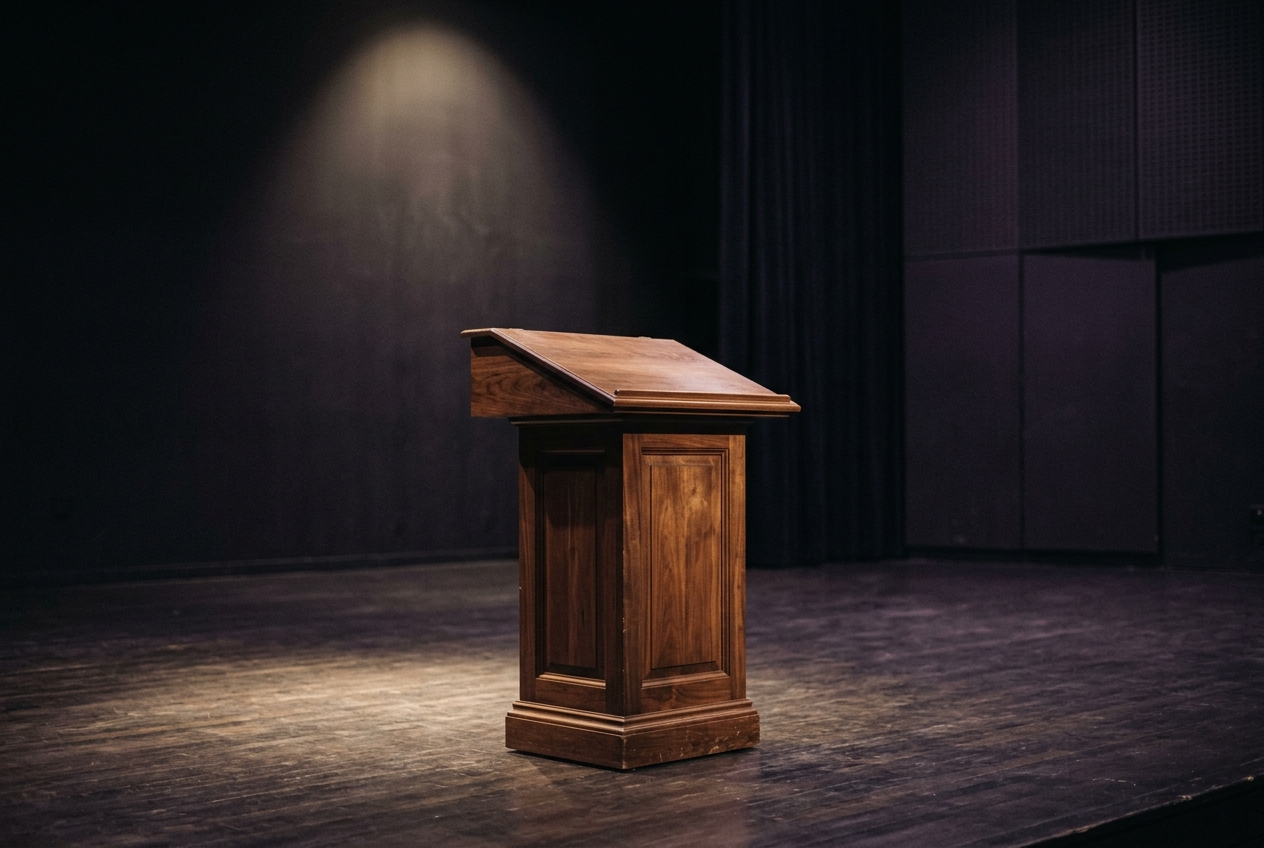
The question of whether to use the lectern or to occupy open space is not merely practical but philosophical. A lectern offers protection and a place to rest your notes, but it also creates distance and can become a barrier between you and your audience. Some speakers cling to it as though it were a life raft, gripping its edges with white knuckles, their torso anchored while only their head and arms move. This creates an impression of constraint, of someone imprisoned by their own setup. Other speakers abandon the lectern entirely and move freely across the stage, only to fall into the trap of purposeless pacing. They wander because they do not know where else to be, and this restlessness communicates uncertainty. The wise approach involves deliberate choice. Use the lectern when you need it, but step away from it to emphasise a particular point or to establish intimacy with your audience. When you do move, move with intention. Travel to a new location on stage because you have something specific to say there, not because your nervous system demands motion.
This brings us to the matter of blocking, the theatrical term for planned movement. Before you step onto a stage, you should already know where you will stand during different sections of your talk. You should know where you will move when you transition from one idea to another, and you should know why. This planning might seem restrictive, but it is liberating. When your body knows where to go, your mind is freed to focus on your message and on connecting with your audience. Uncertainty about what to do with your body consumes cognitive resources that could be devoted to thinking clearly and speaking eloquently.
Gesture is a subject that causes many speakers to freeze with anxiety. They worry about looking artificial or about their hands betraying their nervousness. Yet the hand is an ancient tool of communication, and when used naturally, gestures enhance understanding and engagement. The key lies in allowing gestures to flow from meaning rather than imposing them arbitrarily. If you are describing something small, your hands might come together; if you are describing expansion or growth, your arms might open. These gestures should emerge from your genuine engagement with your ideas, not from a choreography learned beforehand. Avoid repetitive gestures, the kind that become mantras of movement: the speaker who points repeatedly, or who bounces a hand up and down on every other phrase, or who clasps their hands and unclasps them in a compulsive rhythm. Such habits pull attention away from your content and direct it towards your nervous habit instead.
Yet do not mistake the guidance about purposeful movement for an instruction to move constantly. Stillness has its own profound power. There are moments when the most commanding thing a speaker can do is to plant themselves firmly and simply speak. Stillness conveys confidence because it suggests that you do not need to move to hold attention. A politician delivering a crucial statement might stand motionless for an entire paragraph, letting the weight of their words settle into the room. This is not paralysis; it is composure. The difference between nervous stillness and confident stillness lies in the quality of your attention. Are you frozen because you are afraid, or are you still because you are fully present?
Eye contact is the final element of this silent language, and it is perhaps the most revealing. Eyes that dart around the room suggest anxiety or dishonesty. Eyes that fix on a single point suggest either arrogance or detachment. The practice of working the room with your gaze means selecting different audience members in different sections and maintaining eye contact with each for a few seconds before moving on. This creates the impression that you are speaking to each person individually, and it keeps your attention distributed rather than collapsed into fear or self-consciousness. When you make genuine eye contact, you receive feedback from your audience in real time. You see engagement or confusion, interest or fatigue. This information becomes invaluable for adjusting your pace, clarifying a point, or adding energy when the room begins to flag.
How do you rehearse these elements? The answer is not to rehearse them in isolation but to rehearse your entire talk while paying close attention to what your body is doing. Record yourself speaking, and then watch the recording with a specific focus on movement and stance. You will likely notice habits you were entirely unaware of while speaking. Perhaps you sway slightly, or perhaps your gestures are too small to be visible beyond the front row. Perhaps you stand with one hip thrust forward in a posture of false casualness. Once you see these patterns, you can begin to shift them. Some speakers benefit from practising in front of a mirror, though this must be done carefully to avoid becoming self-conscious. Others find it helpful to practise in the actual space where they will speak, walking the stage and discovering the geometry of the room.
The body on stage is not separate from the message being delivered. It is part of the message. Every shift of weight, every gesture, every moment of stillness either reinforces your words or contradicts them. The speaker who understands this has gained a profound advantage. They will own the space not through bombast or performance, but through genuine integration of body and voice, through movement that serves meaning rather than servicing anxiety. What might you discover about your own presence if you watched yourself with the same careful attention that your audience will bring to watching you?