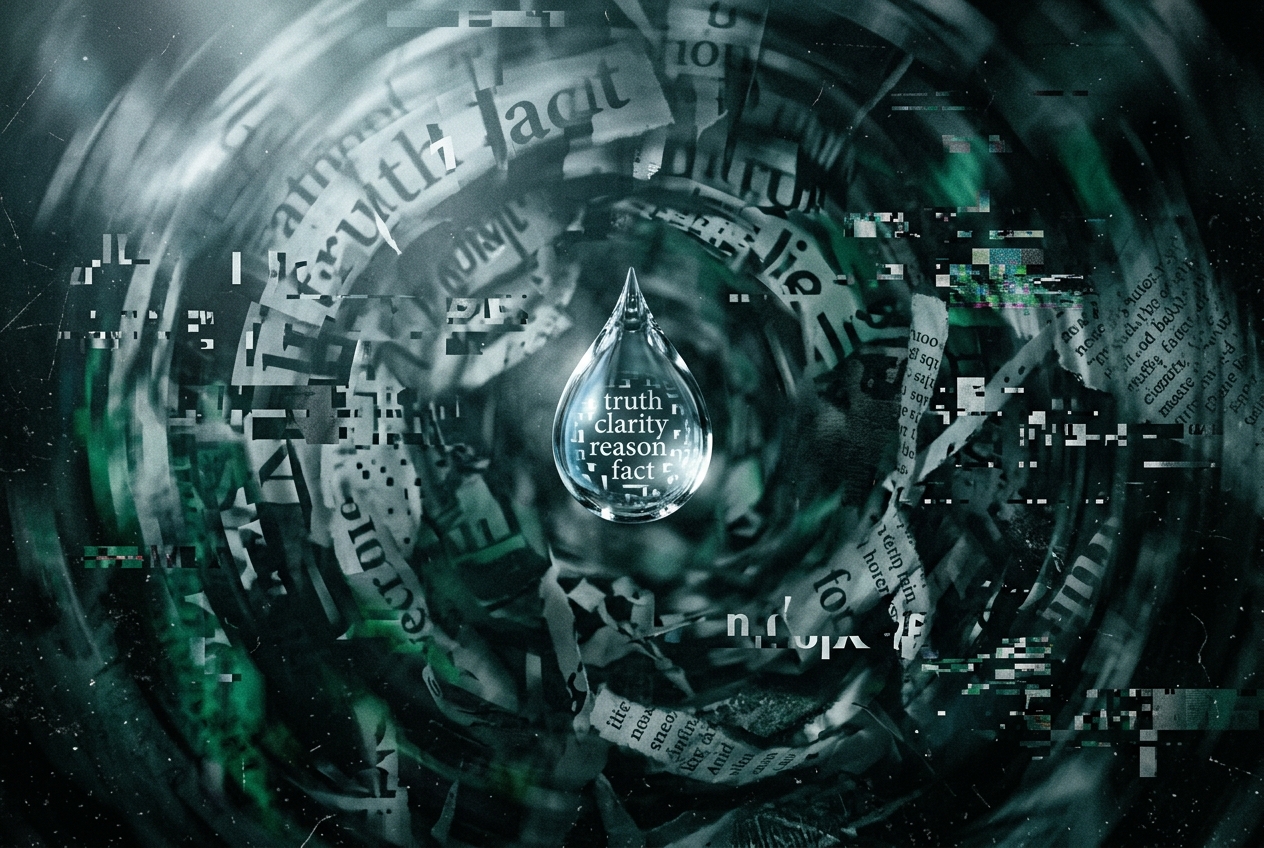
Misinformation and Disinformation: How Can We Combat the New Medium
Written by The Pilgrim ·
Every day we are exposed to more information than any previous generation could have imagined. News, opinion, rumour and propaganda arrive through the same small screen, often in the same format and at the same speed. Some of it is accurate, some of it is mistaken and some of it is deliberately false. Distinguishing between them has become one of the most important skills of modern life. This article examines misinformation and disinformation, asks why they spread so effectively, and considers how each of us might combat them in what has become a genuinely new medium.
It is worth beginning with a distinction. Misinformation is false or misleading information that is shared without the intention to deceive. A person who forwards an inaccurate health tip because they sincerely believe it is spreading misinformation. Disinformation, by contrast, is false information created and spread deliberately, in order to mislead, to profit or to cause harm. The difference matters, because the people who share misinformation are usually ordinary citizens acting in good faith, while those who create disinformation are often organised, well funded and highly skilled. The first problem calls for education and patience; the second calls for vigilance and, at times, for regulation.
False information is not new. Rumours, forged documents and wartime propaganda are as old as politics itself. What has changed is the speed, the scale and the cost. In 2018, researchers at the Massachusetts Institute of Technology, led by Soroush Vosoughi, studied the spread of around one hundred and twenty six thousand news stories on Twitter over more than a decade. They found that false stories spread farther, faster and more widely than true ones, and that false news was around seventy per cent more likely to be shared. Crucially, the main drivers were not automated accounts but human beings. False stories tended to be more novel and more emotionally striking, and novelty and emotion are precisely what make us want to share.
Our own minds play a significant role. Psychologists have identified the illusory truth effect, first described in the 1970s, in which a statement becomes more believable simply because we have encountered it repeatedly. Confirmation bias leads us to accept information that supports what we already believe and to scrutinise information that challenges it. When a claim makes us angry or afraid, our capacity for careful reasoning narrows. Disinformation campaigns understand these weaknesses well, and they are designed to exploit them, often by attaching false claims to genuine feelings of frustration, injustice or fear.
The new medium adds further complications. Social media platforms are designed to show us content that will keep us engaged, and content that provokes strong emotion tends to perform well. Algorithms may therefore amplify the most divisive material without anyone intending them to. Artificial intelligence now allows convincing images, voices and videos to be created cheaply, so that seeing is no longer believing. And because information arrives stripped of its original context, a genuine photograph from one event can easily be presented as evidence of another.
What, then, can be done? One response is regulation, and governments in many countries, including the United Kingdom through the Online Safety Act, have begun to place new duties on large platforms. Regulation raises difficult questions, however, about who decides what is true and how to protect freedom of expression. A healthy democracy cannot simply hand the definition of truth to governments or to technology companies. Much of the burden, therefore, falls on individuals and on education.
Fortunately, research suggests that individuals can be taught to resist. Psychologists at the University of Cambridge, including Sander van der Linden, have developed an approach known as prebunking or inoculation. Just as a vaccine exposes the body to a weakened form of a virus, prebunking exposes people to weakened examples of manipulation techniques, such as emotional language, false experts and conspiracy reasoning, so that they recognise them later. Their online game Bad News, in which players take on the role of a disinformation producer, has been shown in studies to improve people's ability to spot manipulative content.
Another effective technique is lateral reading. Researchers at Stanford University studied how professional fact checkers evaluate websites and found that, rather than reading a page carefully from top to bottom, they quickly left it and opened new tabs to find out what other sources said about it. Students and even highly educated academics, by contrast, tended to stay on the page and be persuaded by its professional appearance. The lesson is simple and powerful: to judge a source, look at what others say about it, not only at what it says about itself.
Several countries have taken this kind of education seriously. Finland, which regularly ranks among the most resilient nations in Europe against disinformation, teaches media literacy across the school curriculum, from mathematics lessons on misleading statistics to history lessons on propaganda. The aim is not to tell young people what to believe, but to give them the habits of mind with which to evaluate claims for themselves.
For each of us, a few habits can make a considerable difference. Pause before sharing, especially when a story makes you feel angry, afraid or triumphant. Ask who created the information and why. Check whether reputable sources are reporting the same thing. Be particularly careful with images and videos that seem designed to shock. And be willing to correct your own mistakes publicly, since an honest correction does more for the health of public conversation than a hundred silent deletions.
So what can we conclude? Misinformation and disinformation are not problems that technology alone will solve, nor problems that can be left entirely to governments. They exploit the speed of the new medium, but they succeed because they appeal to familiar weaknesses in human thinking. The most effective defence is therefore a population of thoughtful, sceptical and well informed citizens who understand how manipulation works and who take responsibility for what they share.
Perhaps the hardest questions are the most personal. When did you last change your mind because of evidence, rather than because of the people around you? How often do you check a claim that confirms what you already believe, compared with one that challenges it? If you discovered tomorrow that something you had shared was false, would you correct it as publicly as you shared it? And in a world where anyone can publish anything, what kind of reader, and what kind of sharer, do you choose to be?
BWGELA, in the spirit of OER, grants the Creative Commons Licence CC BY-NC-SA 4.0 to the reader, to include the attribution: ‘Misinformation and Disinformation: How Can We Combat the New Medium’ scripted by the Pilgrim BWGELA @ www.bwgela.com 2026.