Maya in the Metaverse: Shankara and the Infinite Scroll of Digital Delusion
Written by The Pilgrim ·
When does the digital notification that promises connection actually dissolve our sense of self? Might an ancient Indian philosopher have recognised in our glowing screens the very mechanism of illusion he spent his life illuminating? And if the rope we mistake for a snake in dim light was merely a teaching tool for the nature of reality itself, what becomes of us when we live perpetually in that dimness, scrolling endlessly through a manufactured world?
Adi Shankara, the eighth-century Indian philosopher and spiritual teacher, developed a system of thought called Advaita Vedanta, which means non-dualism. At its heart lies a deceptively simple yet profoundly unsettling idea: the world we perceive, the empirical reality of our daily experience, is not ultimately real. This is not nihilism nor pessimism but rather a precise philosophical claim about the nature of existence. Shankara distinguished between Brahman, the ultimate reality that is pure consciousness itself, and the phenomenal world of objects, persons and experiences that appear to exist but lack fundamental reality. He called this appearance Maya, a Sanskrit term that means illusion or appearance. Yet Maya is not mere hallucination. It is a real appearance, a genuine presentation to consciousness, but it does not possess the kind of ultimate existence that Brahman alone possesses.
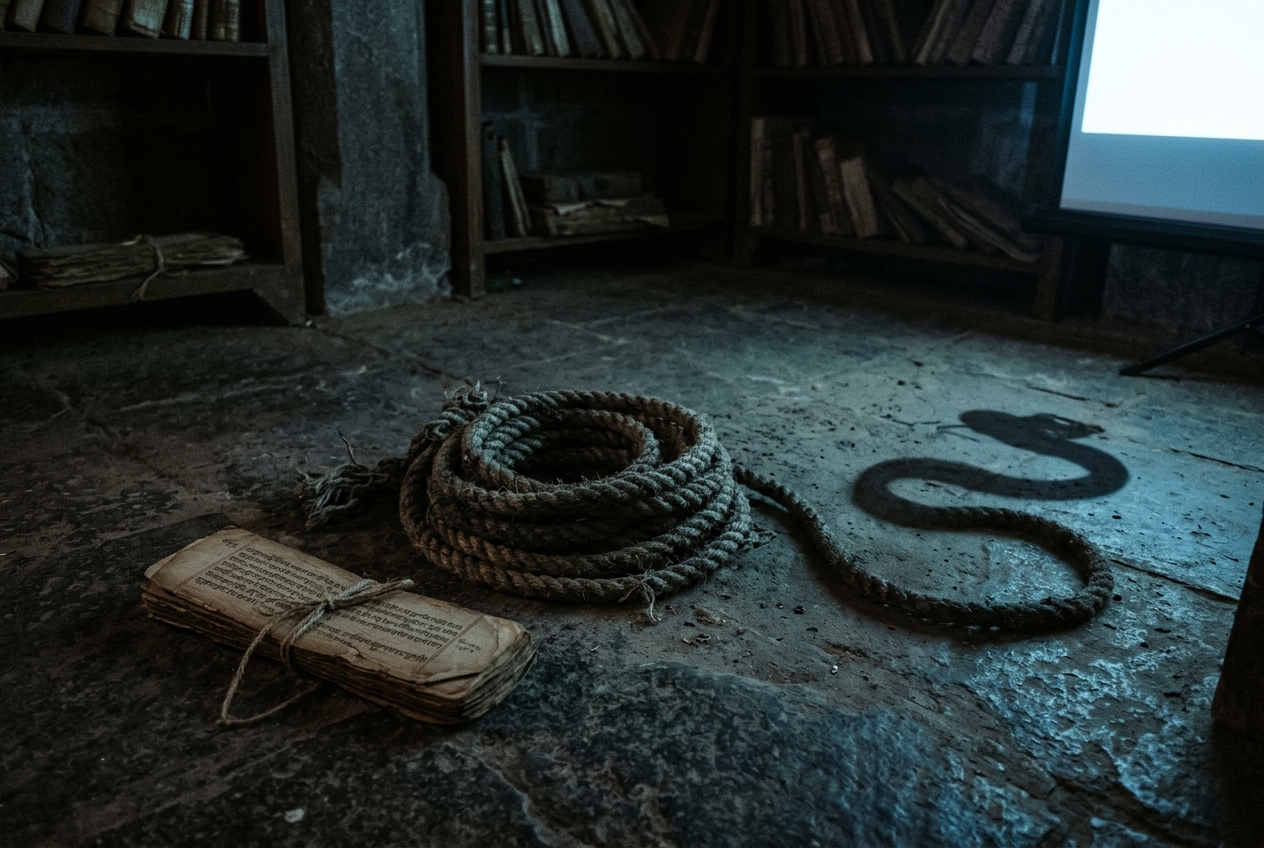
To communicate this distinction, Shankara offered a celebrated metaphor. In dim light, one might perceive a rope lying on the ground and mistake it for a snake. The perception is genuine; something is indeed appearing to the perceiver. The error lies not in the perception itself but in the identification, in the superimposition of the idea of snakeness onto what is actually just rope. One sees the rope, but does not see it as rope. Once sufficient light arrives or one moves closer, the error dissolves. The snake was never there. Only rope was ever present. This is not a claim about epistemology alone. It reveals something profound about the structure of consciousness and reality. The false perception existed only in ignorance, in Avidya. That darkness was itself the necessary condition for the illusion to persist.
Now consider the architecture of contemporary digital life. We inhabit a space that Shankara might recognise instantly as a realm of systematised Maya. The infinite scroll, that bottomless feed of images, opinions, achievements and crises, presents itself as a complete world. Each notification arrives with the weight of reality. Each like, each share, each algorithmic promotion registers as genuine validation or genuine harm. We have built our contemporary consciousness in the dim light of these screens, and in that dimness, we mistake the shadow play for substance. We mistake engagement metrics for worth. We mistake the curated image for the person. We mistake the endless novelty for knowledge.
The mechanisms that drive our digital engagement are not accidents. They are deliberately engineered to exploit what neuroscience reveals about attention and reward. Variable rewards, those unpredictable reinforcements that keep us scrolling, operate on the same principle that makes gambling compelling. We do not know when the next meaningful interaction will arrive, so we remain in a state of perpetual seeking. The screen itself has become our dim light. In its glow, we superimpose meanings that are not there. We see our own worth reflected back in numbers. We see relationships in the form of broadcast messages. We see reality itself mediated through algorithmic curation, which is to say mediated through the interests of those who profit from our attention.
Shankara would recognise something else as well: the role of Avidya, ignorance, in sustaining this illusion. He did not mean ignorance as mere lack of information. Rather, he meant a positive misidentification, a fundamental covering of true reality by false appearance. In the rope and snake metaphor, ignorance is not an absence but a presence, the particular quality of the dim light that allows the error to flourish. In our digital realm, this ignorance takes the form of what we might call algorithmic habituation. We forget, or perhaps never quite knew, that the feed is curated. We forget that the metrics we are shown have been selected to maximise engagement rather than truthfulness. We forget that the infinite scroll is not a window onto the world but a funhouse mirror, bent and distorted to reflect our biases back to us in intensified form. We exist in the dimness, and the dimness feels normal because we have never known anything else.
Yet Shankara insisted that the illusion is not impenetrable. The rope, though perceived as a snake in dim light, has never actually become a snake. Its true nature has merely been obscured. The remedy for this error is not effort or accumulation of more information but rather the arrival of immediate knowledge, what Shankara called Aparokshananda, direct non-dual knowledge. This is not knowledge about reality as an object of thought but rather a shift in the very point of reference from which one knows at all. One ceases to see as the separate ego and recognises one self as the consciousness within which all appearance occurs.
What would the digital equivalent of this shift look like? It would begin with stepping back from the screen, not necessarily in a permanent way but in a deliberate, conscious way. It would mean recognising the difference between the projection and the projector, between the content that arrives and the awareness to which it arrives. It would mean noticing, with some gentle honesty, how often we reach for the device from a state of existential unease that the device itself cannot actually address. The notification cannot fill the absence it claims to fill. The like cannot validate the self that seeks validation through likes. The endless feed cannot satisfy the hunger it deliberately amplifies.
This recognition, modest as it is, opens a space. It is the space between the rope and the snake, the moment when sufficient light arrives for the error to collapse. One does not need to renounce technology or declare digital life inherently illusory in a way that physical life is not. Rather, one needs to see through the particular way in which these systems invite us to mistake appearance for reality. One needs to recognise that the metrics we are shown, the engagement we pursue, the validation we seek through digital means all rest upon a fundamental confusion about what we actually are and what actually has the power to satisfy us.
Shankara taught that this recognition was available to anyone, not through intellectual argument alone but through direct seeing, through what we might call a kind of penetrating attention. In our time, this might mean pausing the scroll and asking: to whom is this feed appearing? Who is aware of this anxiety? Who is seeking this reassurance? These questions are not meant to generate more thoughts but rather to shift the point from which we are observing the thoughts themselves. From that vantage point, the entire apparatus of digital validation appears for what it is: a genuinely present appearance, a real projection, but one entirely empty of the ultimate significance we have granted it.
So what can we conclude but that the timeless wisdom concerning Maya finds its modern expression in the architecture of our digital lives, and that Shankara offers us not escape from technology but rather a means of seeing through the particular illusion it sustains. The rope has never become a snake. The screen has never become reality. The notification has never possessed the power we attribute to it. To recognise this is not to become disconnected or passive. Rather, it is to act and engage from a place of clarity rather than from the dim light of manufactured urgency and curated anxiety. In that clarity, we might discover that both digital and non-digital life take on a different character entirely, one in which we are no longer desperate supplicants before the altar of the algorithm but conscious agents making deliberate choices about where our awareness, and therefore our very selfhood, is directed.
Questions to Ponder
- 1.
In what specific moments during your day does the distinction between genuine connection and algorithmic engagement become most difficult for you to discern?
- 2.
How might recognising the engineer behind the infinite scroll change the way you experience your own compulsion to keep scrolling?
- 3.
If you were to step back and observe your digital habits as Shankara observed the rope mistaken for a snake, what false identification would become most apparent?
- 4.
As a professional reliant on digital metrics or engagement, how could you begin to separate your self worth from the algorithmic validation systems your work depends upon?
or to write private answers and keep them in My Journal.
BWGELA, in the spirit of OER, grants the Creative Commons Licence CC BY-NC-SA 4.0 to the reader, to include the attribution: ‘Maya in the Metaverse: Shankara and the Infinite Scroll of Digital Delusion’ scripted by the Pilgrim BWGELA @ www.bwgela.com 2026.