Algorithmic Co-Dependency: Is Constant Digital Access Suffocating Modern Intimacy?
Written by The Pilgrim ·
When our partners can see where we are at all times and our every message is tracked, do we still possess the selfhood that love requires? Is the constant availability we now expect of one another a sign of devotion or a slow erosion of the boundaries that make intimacy possible? What happens to love when there is nowhere to hide, not even from ourselves?
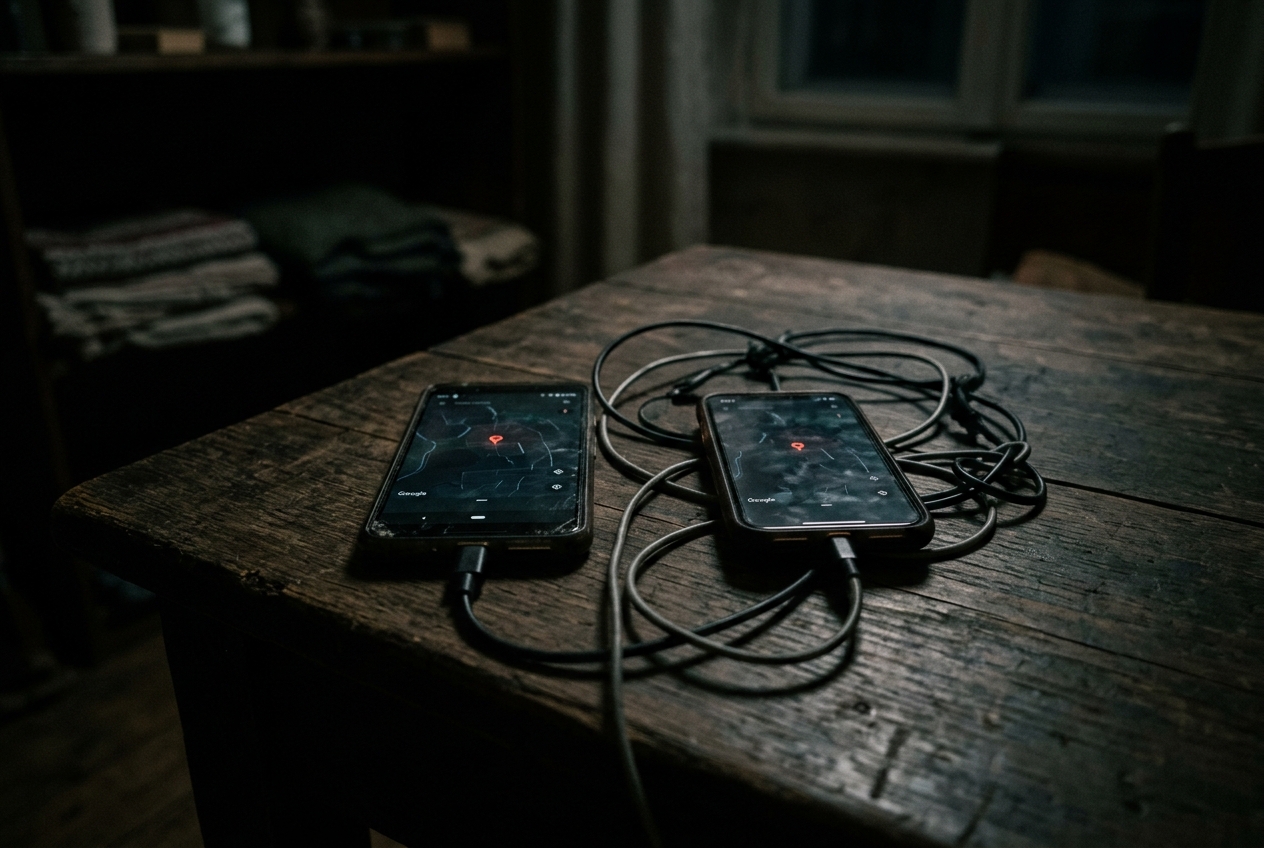
We live in an age of unprecedented transparency. The technology designed to keep us close has become the architecture of a new kind of entanglement. Location sharing, read receipts, notification badges, AI powered messaging suggestions that finish our sentences before we finish our thoughts, these tools promise security and connection. Yet something quietly troubling emerges from beneath this promise. We are witnessing the rise of what might be called algorithmic co dependency, a state in which digital proximity begins to masquerade as genuine intimacy, and constant monitoring begins to feel like love.
Attachment theory, developed by John Bowlby and extended by Mary Ainsworth, tells us that secure attachment requires both proximity and autonomy. An infant needs to know the caregiver is available, but also needs the psychological space to explore the world, to discover agency, to develop a sense of self separate from the attachment figure. Ainsworth described this through the concept of the secure base. The caregiver provides safety, yes, but only so that the child can venture forth, return, venture forth again. This rhythm, this movement between closeness and separateness, is not a weakness in the bond. It is the very foundation of healthy attachment.
Yet when we apply this framework to contemporary digital relationships, something has shifted. The secure base has become omnipresent and inescapable. A partner can know not merely that you are safe, but exactly where you are, with whom, for how long, which route you took home. The technology allows for a kind of surveillance that would have been unthinkable a generation ago, and we have largely accepted it as a normal expression of love. The read receipt transforms a simple message into a document of proof, a timestamp of engagement. To not respond quickly becomes a minor betrayal. To be offline becomes suspicious.
Murray Bowen, a pioneer of family systems theory, introduced the concept of differentiation of self. This refers to the capacity to maintain a sense of individual identity and autonomy whilst being emotionally connected to others. Healthy relationships, Bowen argued, require both partners to be differentiated. They must have their own beliefs, their own internal emotional resources, their own capacity to soothe themselves and to think for themselves. Without differentiation, relationships collapse into fusion, a state in which boundaries blur and one person absorbs the emotional state of the other. Fusion does not produce love. It produces anxiety, control, and resentment masked as devotion.
Consider what happens in a fused digital relationship. If I know that my partner can see my location at any moment, I may begin to regulate my behaviour in ways I do not consciously recognise. I might avoid taking a different route home to avoid questions. I might feel a subtle pressure to be somewhere I said I would be, to do what I said I would do, to exist in a state of perpetual accountability. These small adjustments are not markers of commitment. They are markers of a self that is beginning to contract, to become smaller, to merge with the relationship rather than remain distinct within it. Over time, this contraction accumulates.
The psychologist Esther Perel has written extensively about the paradox of modern relationships. We expect our partner to be simultaneously our greatest source of intimacy and our truest friend, our sexual partner and our intellectual equal, our refuge and our adventure. We have compressed into one relationship what was once distributed across an entire community. And now we have given that one person total access to our digital selves, a window into our behaviour that previous generations could never have imagined. This is not sustainable. It is, in fact, a recipe for the very anxiety and insecurity that technology promises to solve.
Read receipts deserve particular attention here. A small feature, seemingly innocent, yet it transforms communication into a kind of performance. When you know your message has been read, you begin to wait for a response. The absence of that response becomes meaningful. It becomes a statement. But what if the person who read your message is simply busy, or thinking, or has decided they need space to process what you have written? Without that space between message and response, without the possibility of genuine privacy in processing, we lose something essential. We lose the ability to have an interior life. We lose the margin in which genuine thought occurs.
AI powered predictive messaging, with its suggestions and autocompletes, adds another layer to this erosion of selfhood. The algorithm learns how you typically respond and offers that response to you before you have consciously formed it. This is framed as convenience, and perhaps it is. But it is also a peculiar kind of self alienation. You are offered back to yourself as data, as pattern, as prediction. The suggestion appears, and you accept it because it is faster, because it is there, because accepting it requires less energy than formulating your own response. Over time, you may begin to wonder which thoughts are truly yours and which are merely the algorithms best guess at what you would think.
What makes this particularly insidious is that it occurs in the name of love. Nobody imposes location sharing on you. You volunteer for it. You suggest it. You say to your partner, here, take this access to me, and feel the security of knowing where I am at all times. It is framed as an act of love, a gift of transparency. And in some contexts, with clear boundaries and genuine consent, it may be. But when it becomes the default, when it becomes the expected baseline of commitment, when the inability or unwillingness to share is read as infidelity or secrecy, then we have crossed into something else entirely.
The fear of engulfment is a real psychological phenomenon. People differ in their needs for closeness and distance, and these differences are not moral failings. They are variations in how human beings regulate their own sense of safety and selfhood. Some people need more solitude, more space, more capacity to be unknown. In a highly connected digital environment, there is no hiding place. Even stepping away from your phone becomes a form of communication, a statement that you are unavailable, which itself requires justification. The digital world permits no true absence.
What we are beginning to recognise is that healthy love requires what the psychoanalyst Winnicott called the ability to be alone in the presence of another. But also, the ability to be truly alone. Not available, not tracked, not waiting, not performing. Simply absent in the way that allows for genuine rest, genuine privacy, genuine selfhood. When every moment is potentially visible and potentially accountable, we lose the capacity for this kind of being. We become forever present, forever available, forever performing a self that is always subject to observation.
So what can we conclude? Perhaps the challenge of contemporary intimacy is learning to use digital tools without being used by them, to maintain connection without dissolving autonomy, to share access without demanding totality. This requires intention, conversation, and a willingness to accept that love sometimes means relinquishing the comfort of constant proximity. It means trusting that absence is not abandonment, that privacy is not betrayal, and that the healthiest bonds are those in which both people retain the sovereign right to an interior life.
Questions to Ponder
- 1.
How might your capacity for solitude and personal reflection influence your ability to show up fully in intimate relationships rather than diminish it?
- 2.
What difference might it make in your romantic life if you could distinguish between monitoring your partner and genuinely knowing them?
- 3.
When we exchange the freedom to be unknown for the security of constant proximity, what essential human capacities do we risk losing in the transaction?
- 4.
How might our culture of relationship transparency be reshaping what we collectively believe love actually requires, and is that reshaping serving our flourishing?
or to write private answers and keep them in My Journal.
BWGELA, in the spirit of OER, grants the Creative Commons Licence CC BY-NC-SA 4.0 to the reader, to include the attribution: ‘Algorithmic Co-Dependency: Is Constant Digital Access Suffocating Modern Intimacy?’ scripted by the Pilgrim BWGELA @ www.bwgela.com 2026.